
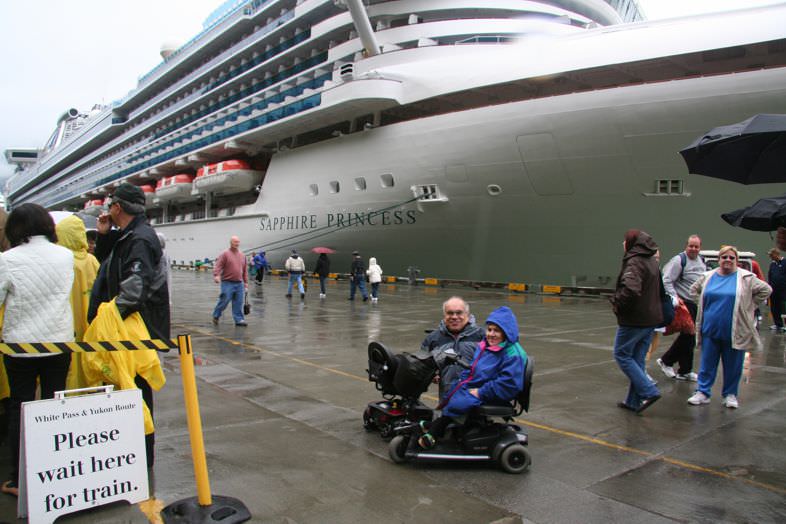
Have you ever heard of “Walking Rollers?” I first heard the term when the United Spinal Association was advertising a Walking Rollers support group for semi-ambulatory part-time wheelchair users. I recognized the term as an accurate description of myself as a sometimes scooter user. As a person with dwarfism measuring 40 inches in height, I definitely don’t come close to the stereotype of a wheelchair user being paralyzed and unable to stand or walk.
Who knows whether this Walking Roller terminology will catch on, but I like it. Will the term eventually override the term “ambulatory wheelchair user” just as crippled was replaced by handicapped, and eventually toppled by disabled? Only time will tell.
Want to subscribe to receive blog updates sign up today!
Whatever term becomes the standard, myself and thousands of people with dwarfism meet the criteria. We can walk short distances independently on firm, level surfaces, but roll on scooter wheels to cover greater distances, where paving is uneven, or to protect ourselves in a moving crowd of pedestrians who won’t see us. Many of us also have limited footsteps in our day for shopping or strolling through a mall, park, museum, or the like. Indeed we count among an estimated 30 to 50 percent of wheelchair/scooter users who are ambulatory!
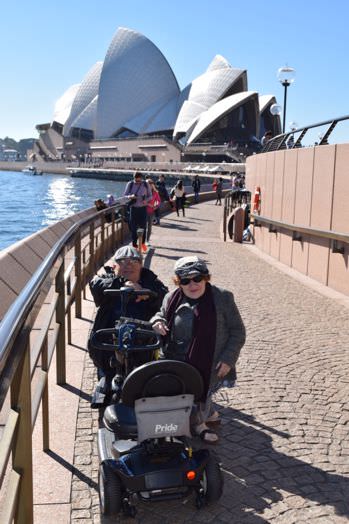
It hasn’t always been this way for me. In my younger years, I walked without any mobility aids. However, with the passing of time, wear and tear on my hip cartilage (a 1953-54 surgical substitute for hip joints), and spontaneous fusion of my ankles, walking even short distances became more painful. Years ago I celebrated the introduction of supermarket mobility carts for customers. As tricky as these carts were for a Little Person to operate—such as the automatic safety cut-off when shifting my weight forward to reach the steering bar—I was incredibly grateful that I didn’t have to collapse in pain after bringing the groceries home. Thankfully there was only one incident announced over the loud speaker—clean up on aisle “9”—when my store scooter knocked a large jar of pickles off the shelf!
Even though I know lots of Little People wouldn’t be caught dead riding in a wheelchair or scooter, as far back as 1981, I was willing to engage the services of a skycap to get me through an airport . The prospect of missing a flight was highly motivating for me to allow myself to be pushed in a wheelchair from one concourse to another or to baggage claim. Besides, experiencing unnecessary pain didn’t make a lot of sense when I had so many places to walk upon arrival.
My husband Robert Van Etten—a rehabilitation engineer was well versed in matching assistive technology to people with disabilities needing help to perform activities of daily living independently. Yet I had not taken his advice personally until a family vacation in Key West about 30 years ago. My inability to keep the pace, constantly tagging along in the rear, and being on the outlook for somewhere to sit down, was spoiling the vacation experience for myself and the whole family. My siblings eventually took charge and borrowed a wheelchair from a local hotel where we were not even guests! Not long after we got home, Robert and I bought a personal mobility scooter; we called it long-term maintenance of the joints not to mention making future vacations more enjoyable.
Decades before, Robert understood what Jeremy Einbinder reported as breakthrough research from Harvard Medical School on September 7, 2026—“this new study has confirmed that using a wheelchair is highly preferable to immobilizing pain.” This research validates the experience of many “walking rollers” who have adopted part-time wheelchair or scooter use as a viable option to alleviating pain. We understand that needing to use a wheelchair is far from a tragedy, last resort, or worst-case scenario. It is liberating and life changing.
I enthusiastically echo the sentiments of other walking rollers:
- “My wheelchair allows me to do more of the things I love, with less detriment to my health.”
- “My mobility aids are a tool that I use to enhance my life, when and how I choose to do so.”
- “Using the wheelchair has given me back some freedoms that I had previously lost, opened up my world, and made it more possible to go shopping, see friends, get around independently, and have some degree of a social life.”
- “I love how much more freedom it gives me on days out. It means I’m not slowing people down and I can do more for longer.”
- It took some real guts to get over my own prejudices about being ‘seen’ in the chair by my own colleagues! Eventually though, I discovered the freedoms that the chair gives me; it enables me to attend events and continue with my life despite my difficulties.
- My wheelchair is my freedom. Prior to using a wheelchair, I had lost almost all of my independence. I couldn’t dream of being able to go anywhere, besides doctors’ appointments and home.
In addition to pain management, walking rollers also switch to wheels to alleviate fatigue or flare-ups of medical conditions; prevent falls due to unsteady balance, dizziness, or syncope; manage seizures, dislocations, muscle weakness, or the like. But whatever reason a person with a disability chooses to be a walking roller, the decision comes at a cost, possibly including the following several negative experiences:
- Being accused of “faking” disability when a member of the public observes the person moving their legs, standing, or walking;
- Breaches of wheelchair etiquette rules, such as refusing to make eye contact, talking to your companion instead of directly to you, insisting on helping even when help is refused, using the person’s wheelchair basket or tray without permission, to name a few; or
- Putting on weight due to a reduction in the physical exertion that comes from walking.
As a result, walking rollers need to prepare themselves for how to engage with an uneducated public and curb weight gain by not giving up on safe and pain free walking and to find new ways to burn off calories.
Leave a comment if this Dwarfism Awareness / Advocacy Month post helped you see dwarfism in a new way.
#AmbulatoryWheelchairUsersExist
For resources that informed this post, go to https://angelamuirvanetten.com/resources/.
For blog posts previously published in October during National Dwarfism Awareness Month, see the following:
- “Physical Therapy Journey.” Van Etten blog post. October 1, 2025. https://angelamuirvanetten.com/physical-therapy-journey/
- “DWARFISM ARTS AND ADVOCACY: Creating Our Own Positive Identity.” Blog post guest, Dr. Erin Pritchard, Senior Lecturer in Disability Studies, Liverpool Hope University, United Kingdom. October 21, 2024. https://angelamuirvanetten.com/dwarfism-arts-and-advocacy-creating-our-own-positive-identity/
- “Calling Disabled Candidates to Help America Vote.” Van Etten blog post. October 30, 2023. https://angelamuirvanetten.com/calling-disabled-candidates-to-help-america-vote/
- National Disability Employment Awareness Month:
- “Breaking Free From Lawyer Stereotypes.” Van Etten blog post. October 16, 2023. https://angelamuirvanetten.com/breaking-free-from-lawyer-stereotypes/
- “Lessons from my 40-year Law Career.” Van Etten blog post. October 10, 2022. https://angelamuirvanetten.com/lessons-from-my-40-year-law-career/
- International Dwarfism Awareness Day.
- International Dwarfism Awareness Day. Van Etten blog post. October 23, 2023, https://angelamuirvanetten.com/international-dwarfism-awareness-day/
- “Dwarfism Sensitivity & Awareness.” Van Etten Blog post. October 24, 2022. https://angelamuirvanetten.com/dwarfism-sensitivity–awareness/
- “Add Teeth Not Candles for Birthday of Air Carrier Access Act (ACAA).” Van Etten blog post. October 3, 2022, https://angelamuirvanetten.com/air-carrier-access-act/
- “No Wheelchairs Allowed.” Van Etten blog post. October 18, 2021. https://angelamuirvanetten.com/no-wheelchairs-allowed/
- National Stop Bullying Day. “Say No To Bullies.” Van Etten Blog post. October 11, 2021. https://angelamuirvanetten.com/say-no-to-bullies/
- “Making the Impossible Happen.” Van Etten blog post. October 4, 2021. https://angelamuirvanetten.com/making-the-impossible-happen/
- “Car Rental and Marriage Mulligans.” Van Etten blog post. October 19, 2020. https://angelamuirvanetten.com/car-rental-and-marriage-mulligans/