
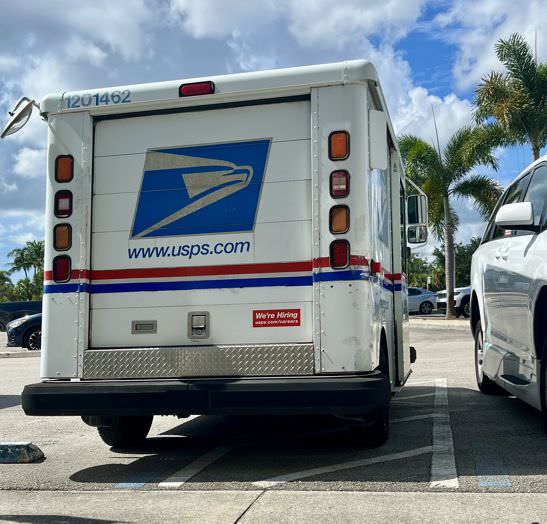
On a cloudy September morning, I was pleased to find an open van accessible parking space right in front of my dentist’s office. However, I was displeased after my appointment to return and find an official postal service vehicle parked illegally in the access aisle next to my van. The postal van covered the extra five feet marked off with diagonal lines between our vehicles and obliterated the space the ramp required to deploy! As a result, I could not lower the ramp or board the van with my scooter.
Want to subscribe to receive blog updates sign up today!
Years before I personally needed van accessible parking with an access aisle, I observed this same parking dilemma by a couple who were both wheelchairs users. A car had parked so close to their van that they could not deploy their ramp and were barred from boarding. The offending driver was nowhere in sight and could have been anywhere in the fairgrounds for an indeterminate amount of time. Thankfully, they solved the problem by recruiting a deputy sheriff to back their van out of the accessible parking space into the driveway so that they could access their vehicle.
In my case, the lawless postal driver was in sight and responded to the request to move his vehicle. However, he was unapologetic and without making eye contact said, “I was only going to be a minute.” When I observed how many mailboxes he was servicing, I knew it would be more like ten minutes. His attitude also told me his behavior was unlikely to change and he would probably park there again in the future.
Despite access aisles being marked to discourage drivers from parking in or using them for other purposes, obstructions are also caused by shopping carts, motorcycles, delivery pallets, construction equipment, and snow piles. Add to this the public’s abuse of accessible parking spaces that don’t have access aisles. Lawless drivers deliberately park in these spaces reserved for disabled drivers or passengers having one or more of the following disabilities:
- Inability to walk 200 feet without resting.
- Use of portable oxygen.
- Serious heart impairments.
- Severe walking limitations.
- Meet lung-function criteria.
- Need walking assistance.
For the 30 plus million people in the United States with mobility disabilities, searching for accessible parking has the makings of a nightmare excursion. According to the Accessible Parking Coalition,
- 80% report that either enforcement was not adequate (46%) or that there was no enforcement at all (34%).
- 70% say their decision to drive or ride is influenced by parking availability.
- 69% have problems finding accessible parking in their communities.
- 62% would be more likely to drive or ride if parking was more available.
- 52% have decided not to make a trip because of concerns about finding parking.
A United Spinal Association survey of state agencies that tracked accessible parking data in 2023-24, confirmed that the parking demand far exceeds the supply—only two accessible parking spaces are available for every five vehicles that need it. This shortage is exacerbated by flagrant abuses of existing accessible parking, including: (1) parking in a disabled spot without a permit or placard; (2) using a placard for activities that do not involve the actual disability; (3) using an expired or invalid permit, such as where the holder has died; and, for the most common form of misuse (4) using someone else’s permit when the eligible person is not being transported. Some accessible parking spaces have even been hijacked by businesses for electronic vehicle charging stations; curbside pick-up; outdoor eating; and, in Florida, for pregnant women.
In recent years, the production of fraudulent disabled parking permits has proliferated. Medical documentation is frequently falsified. For example, a forged certification may falsely attribute medical findings or a signature to a clinician. This was the case in Doral, Florida when in August 2026 the Miami-Dade Sheriff’s Office deputies took down a disabled parking pass fraud ring—the doctor whose signature was on the permit applications had retired in 2020 and passed away in 2025. Consequently, fraudulent permits were revoked and penalties included fines up to $1,000 or jail time.
In August 2023, the Florida Highway Patrol, Bureau of Criminal Investigations and Intelligence announced the arrest of seven individuals on charges related to the fraudulent procurement, issuance and sale of approximately 700 disability parking placards. Florida Attorney General Ashley Moody was infuriated by this exploitation and is reported as saying, “It’s even more disheartening that there were hundreds of buyers eager to pay for the ill-gotten privilege to essentially steal parking spots from people with disabilities.”
Online scam sites are also marketing instant approvals and guaranteed outcomes without licensed clinician involvement, state specific documentation, or adequate identity verification. In this telehealth model, a network of doctors review claims and submit the necessary paperwork for disability parking permits, despite having no history with the applicants and no tangible way to verify their claims. In its first year of operation, ParkingMD claimed they assisted 33,000 people to obtain placards. Their promotional ad is highly suggestive of a target market of people without disabilities pursuing convenience rather than equal access.
So how do we respond to the supply and demand imbalance, public ignorance, abuse, and fraud? I concur with the following recommendations from Josh Schorr of the U.S. Access Board and Steve Lieberman of the United Spinal Association:
- Increase the parking supply to meet the existing demand
- States and localities should increase accessible parking minimum standards above the current federal minimum—ten percent for total accessible parking spaces and two percent total van accessible spaces.
- States and localities should not pass laws— like Florida’s “pregnancy parking” law—to allow people who don’t meet the Americans with Disabilities Act (ADA) definition of disability to park in ADA-defined accessible parking spaces.
- Increase federal minimum standards.
2. Increase awareness and education regarding common parking barriers
All states should require that:
- Driver’s education courses cover accessible parking laws.
- State driving exams include questions about accessible parking spaces and access aisles.
- When a placard is obtained, the placard holder receives information about accessible parking laws.
- Access aisle signage meets high standards.
- Public awareness campaigns on accessible parking education focus on keeping access aisles clear of obstructions, parking inside the lines, and deterring “just for a minute” parking and placard fraud.
3. Increase enforcement
- States, counties, and localities should make accessible parking enforcement a greater priority.
- States should work with the disability community and law enforcement to identify and adopt new anti-fraud elements for disability placards as a step towards developing a set of national standards.
- States should ban the practice of one-time telehealth visits to obtain placards.
- States should not do away with placard renewals.
- States should explicitly empower law enforcement to conduct accessible parking enforcement in private lots and garages and ensure that law enforcement officers are aware that they can conduct such enforcement.
As Dee Harding, author of The Complete Guide to Preventing Disability Parking Permit Fraud in the United States, rightly said, “accessible parking is not a perk. It is part of a broader civil rights framework that supports equal access to public accommodations, services, and facilities.”
For resources that informed this post, go to https://angelamuirvanetten.com/resources/
For prior posts on accessible parking that have reached Angela Muir Van Etten’s “bee in the bonnet” status, go to:
- Van Accessible Parking Predicament, November 13, 2023. https://angelamuirvanetten.com/van-accessible-parking-predicament/
- “Finding Hugo: Our Wheelchair Accessible Van.” September 26, 2022. https://angelamuirvanetten.com/finding-hugo-our-wheelchair-accessible-van/
- “Vigilante Policing of Disabled Parking Spaces.” February 8, 2021. https://angelamuirvanetten.com/vigilante-policing-of-disabled-parking-spaces/