Categories
International

Remember Ukrainians with Disabilities

ukraine flag dove

Invasion. Call to arms. Mass exodus. Air raid sirens. War crimes. Nuclear war threat. None of this crossed my mind when planning today’s blog post. But unprovoked Russian aggression against Ukraine compelled me to write about the greatest unleashing of evil since World War II.

Horrific scenes in the hourly news cycles are hard enough to bear, but are only a glimpse of the horror. The agony imposed on the estimated 2.7 million people with disabilities is unimaginable.

Want to subscribe to receive blog updates sign up today!

  • How many will die due to medical facilities—once used for treating life threatening conditions like cancer, organ failure, and COVID-19—being converted to emergency care for the injured?
  • How many will die due to starvation and unavailability of medications?
  • How are people with intellectual or mental health impairments coping with the trauma?
  • How do wheelchair users exit high rise buildings when power outages shut down elevators and how do they get downstairs into basements and bomb shelters?
  • How do those using power wheelchairs and respiratory equipment charge their batteries?
  • Who will pay for wheelchair accessible vehicles to transport their users to safety across the border?
  • Who will help the tens of thousands of children with disabilities living in orphanages and institutions?
  • How do people needing personal care services find a replacement for a caregiver who has evacuated the country?
  • Where will refugees needing accessible accommodation find shelter?
  • How many will acquire disabilities as a result of the war?

Sanctions, military supplies, solidarity and support have come from world leaders, cities, charities, and individual citizens. Flying the Ukrainian flag and sunflower displays are laudable, but do nothing to help civilians fleeing with their children and pets and “farewelling” loved ones who must stay behind to fight. So what can we do?

First and foremost we can pray for God’s intervention—He can make the impossible happen. History attests to this. In ancient times, the Israelites often defeated enemies with greater military strength. Well known examples include the defeat of Egypt led by Moses (Exodus 14), Midian led by Gideon (Judges 7), and Jericho led by Joshua (Joshua 6). Modern day examples include national days of prayer and fasting during World War II when British soldiers were trapped at Dunkirk, Hitler planned to invade Britain, and prior to D-Day.

Today as Ukraine confronts an enemy more powerful and numerous, let’s pray for God to hear their cry and intervene on their behalf. May God give President Zelensky and the Ukrainian people courage and confidence to fight under His command.

            Second we can give to charities with an established track record of working in Ukraine for people with disabilities. On this front, I support Joni and Friends International Disability Center. A regional in-country coordinator and her team have already proved their effectiveness by boldly evacuating 35 people with severe disabilities and their families and caregivers across the border into Poland. As they plan more rescues, they seek our prayers and ask us not to forget Ukrainians with disabilities.

Categories
Celebrations Education

So Where Do You Wear A White Horse Hair Wig?

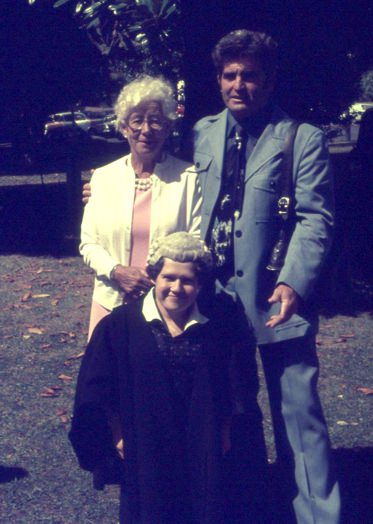
New Zealand bar admission with Nana & Dad
Angela stands at elbow height of her father and grandmother standing behind her. All three are formally dressed: Angela in a black robe, white collar, and white horse hair wig; Nana in a pink dress, white cardigan and white necklace; and dad in a blue suit and tie with a camera strap draped over his shoulder.

My presence in a bar has been challenged more than once, but exchange the bouncer for the bailiff and you’ll find me unchallenged at the bar of the local court. Eligibility for this bar is based on a certificate of admission to the High Court of New Zealand not a certificate of birth.

On the first day of February 1977, the order of admission was made by the presiding judge. Indeed, the day actually carried an air of fantasy. It began with a parallel to “Goldilocks and the Three Bears.” I felt like big daddy bear robbed of chair, porridge, and bed. When I came to sign the Roll of Barristers and Solicitors, somebody had signed on the line reserved for my name.

Want to subscribe to receive blog updates sign up today?

In all the excitement, one of my peers had signed her name in my space. There was nowhere for me to sign.

The story took a different turn when the Deputy Registrar stepped into the picture. As though a fairy godmother waving her wand, she took out an eraser and removed all traces of the error. With it she also wiped out any suggestions of fantasy. In reality, I was standing there at age 23 ready to enter my name on the roll and to begin my career as a Barrister and Solicitor in law.

Note: In 1977 it was customary for New Zealanders to qualify as an attorney at about age 23, as students entered the four-year law degree program at age 18, without being required to complete an undergraduate degree. However, a first year of general studies, known as pre-law, had to be successfully completed before a decision as to law school admission was made. A fifth year of part time study, while working as a clerk in a law office, was spent qualifying for admission to the bar.

I stood with pride alongside my fellow classmates also taking the oath of admission. As predicted, only half of those who began the five-year law program stood with us on this day. We were at the end of a long road and were finally entitled to speak before the court.

The occasion called for traditional dress—a white horse hair wig and an expensively pleated heavy black legal robe. I couldn’t help thinking how much we all looked like over-dressed penguins, but the apparel was a prerequisite to appearance and the right to speak as counsel in court. It was no time to voice objections. Instead we all robed meekly and took the oath put to us. We hoped other people understood that appearances aren’t the most important thing in the world.

That hope was put to a severe test when I discovered that prospective employers were very interested in appearances. This post is excerpted from Chapter 3, At the Bar, in “Dwarfs Don’t Live in Doll Houses,” the first book in my dwarfism memoir trilogy covering my first quarter century. Click on the link to read what others say about the book and find out where to get your copy: https://angelamuirvanetten.com/dwarfs-dont-live-in-doll-houses/.

Categories
God's protection

Navigating February Blizzards

Blizzard

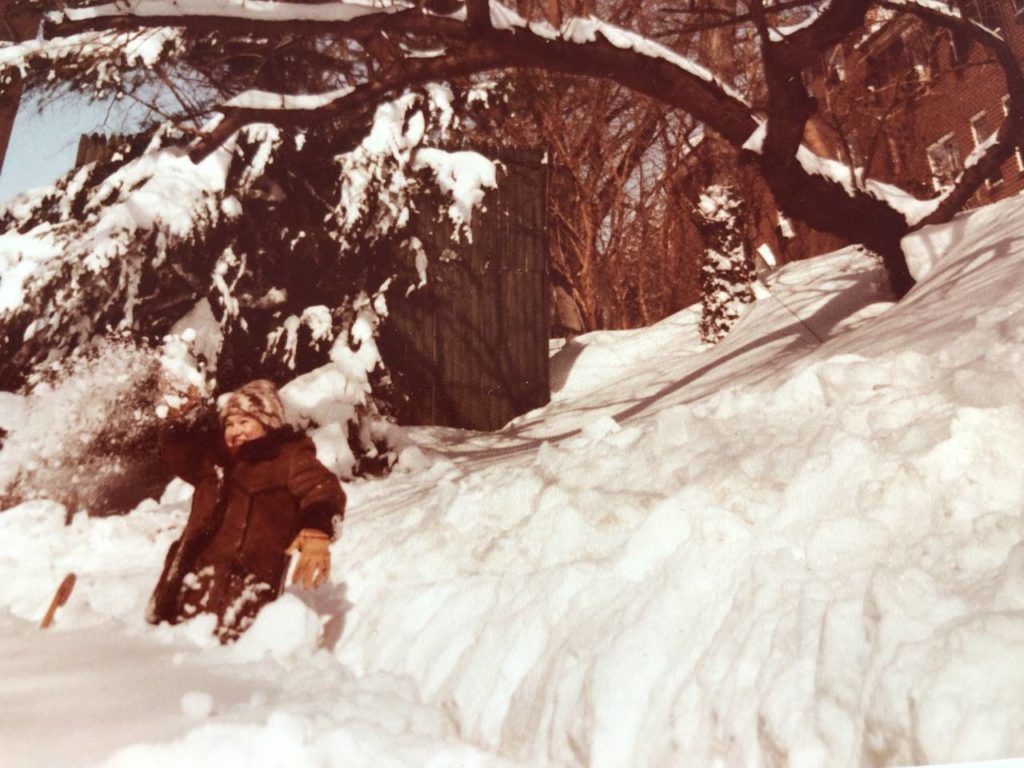
Within two weeks of our first time attending the Second Presbyterian Church, Reverend Smart made an unannounced home visit. We were shocked because this was February 1983—when almost 23 inches of snow covered the city after the second biggest snowstorm on Baltimore’s record books. But the Reverend walked the half mile from the church to our apartment. It was a safe assumption that he would find us at home. We benefited from the reminder that despite the storms of life, God always shows us a way through. Just like He did in February 1984 when I took the Ohio bar exam in Columbus, three hours south of Cleveland.

Want to subscribe to receive blog updates sign up today!

Because we only had one car, Robert had to drive me to Columbus on the weekend, leave me at a motel near the exam site, and drive back to Cleveland for work on Monday. I awoke on Monday morning to see snow falling—nothing unusual about that in an Ohio winter. However, to wake up on Tuesday—the first of three exam days—and still see snow falling was alarming. I had prepared for the exam with endless hours of study, but had not prepared for a blizzard that dumped about 12 inches of snow. My fear was that my pre-ordered cab would be a no-show. If I did not get to the exam site on time, locked doors would keep me from taking the exam for another six months.

I thanked God when cabs came for me at both the beginning and end of the day. It was a blessing to meet Yvonne and Paula at dinner in the restaurant across the street from the motel. They recognized me from the exam site and invited me to join them.

I would never have made it back to the motel without their help. They held onto me—one on each side—to stop me slipping and sliding in the snow and ice. When blocked by a wall of snow left in the wake of a snow plow at the motel driveway, a motel employee shoveled the snow and helped lift me over the snow bank. Preparing for such obstacles was not in the bar review material.

It was definitely a God-ordained bonding experience with Yvonne and Paula. The three of us teamed up for the next two days for ongoing support, meals, and rides. Our meal the second night at the Spaghetti Warehouse perked up our spirits and gave us the energy to get through the last grueling exam day.

On May 2, 1984, I woke up at 6:45 a.m. in a cold sweat. It was the day to call in for the bar exam results and I dreamed that I had failed.

When the operator reported excitedly, “You passed!” I was relieved to learn that not all dreams—or nightmares, in this case—come true.

I was just as excited to learn that my bar-exam friends, Paula and Yvonne, had also passed.

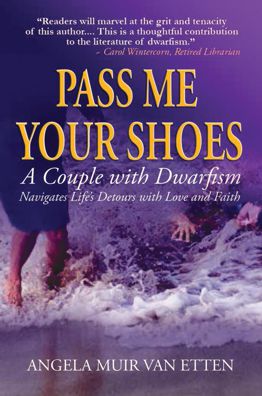
This post is a condensed excerpt from chapter 7 in “Pass Me Your Shoes: A Couple with Dwarfism Navigate Life’s Detours with Love and Faith.” Click on the title for a Look inside at the first few chapters, endorsements, Table of Contents, and a wedding photo. Link to retail sites on my website at https://angelamuirvanetten.com/books.

Categories
Relationships

Honeymoon Romance Takes A Dive

Pass Me Your Shoes

Our Oahu leis made of fragrant yellow ilima flowers put us both in the mood for romance, though our ideas of how to achieve this were quite different. I thought it would be romantic to walk back to our hotel along the beach. Bobby preferred to walk on the sidewalk along the main road. As a Floridian, Bobby saw no special attraction in traversing sand and surf, but wanting to please his bride, he agreed.

I was ready to walk barefoot and enjoy the warm water caressing our feet, while Bobby preferred wearing his shoes and socks, suit and tie, in the style of an English gentleman. Thus, he was reluctant to go anywhere near the water because he did not want to get his shoes wet.

Want to subscribe to receive blog updates sign up today!

Again, for the sake of his bride, he not only took off his shoes and socks, but he also walked with me hand-in-hand as the water lapped our feet. He even perked up when the skyline of Waikiki and Diamond Head presented a perfect backdrop for him to photograph me in the sparkling water.

Soon thereafter, romance and perfection took a dive. With the roar of three waves piling one on top of the other, I let go of Bobby’s hand, lifted my dress, and braced for the crashing waves. Regrettably, Bobby anticipated nothing—his first indication of trouble was when he found himself flailing prostrate in the swirling waves and clawing in the sand to resist the undertow threatening to pull him out to sea.

He wondered if I was looking for evidence of his demise when he heard me calling out, “Pass me your shoes! PASS ME YOUR SHOES!”

Of course, it was nothing so sinister. I had withstood the waves by digging my toes deep into the sand, but could do nothing to stop Bobby’s plunge. My first thought was to salvage his shoes since he had been so adamant about not getting them wet.

I helped Bobby to his feet and noticed something far worse than wet shoes—salt water was streaming out of the camera case still hanging around his neck. His camera was ruined. I captured the moment on my cheap camera and titled the picture: Total Trauma. Somehow Bobby’s photo of me on Waikiki Beach survived the salt water—our $200 picture represented the replacement cost of the camera, not the value of the subject matter. This was when I learned that a new camera was a nonnegotiable budget item. I did restrain Bobby from bringing the ruined camera on the plane in a bucket of water to prevent further corrosion.

This post is excerpted from “Pass Me Your Shoes: A Couple with Dwarfism Navigate Life’s Detours with Love and Faith.” Click on the title for a Look inside at the books first few chapters, endorsements, Table of Contents, and a wedding photo. Link to retail sites on my website at https://angelamuirvanetten.com/books.

Categories
Inclusion

Turning 18: Facebook Jolt and User Caution

smartphone

Facebook’s growth spurt ended on the eve of its’ 18th birthday. For the first time ever, the number of daily active users dropped. A tremendous jolt for a business that made growth charts obsolete.

Facebook burst out of the gate with a 1,000% growth rate within 24 hours of its’ February 4, 2004 launch. And growing by leaps and bounds took on new meaning as users grew from millions to billions—one million in one year (2004), one billion in 2012, and almost three billion in 2022.

But hold the champagne. The drop in fourth quarter income triggered the biggest ever daily stock market loss for a U.S. firm, namely Meta, Facebook’s parent company.

Want to subscribe to receive blog updates sign up today!

Disturbing for Facebook, but why should people with disabilities care? The same reason as the other three billion users! We count.

Because Facebook allows anyone with an email address and real-life identity to have an account, users with disabilities are included without typical exclusionary barriers. As a result, we are among the multitudes affected by Facebook’s foibles and fumbles. So as Facebook presumably reflects on its’ path forward, users need to reflect on how we spend our time on Facebook.

Let’s start with appreciating what Facebook does for users:

  • Dissolves global boundaries and connects users ready to share what’s happening in our lives.
  • With Facebook’s 2016 shift toward meaningful communities, organizations like Little People of America and people with dwarfism contribute to the count of ten million groups. People with dwarfism and their associates join various groups in which they receive news, support, ideas, answers to questions, et al. For example, an advocacy group solicits action on cultural and social issues negatively impacting people of short stature, such as “midget” as a descriptor of products, dehumanizing entertainment like dwarf tossing, and barriers in the built environment.
  • Safety Check allows people in or near disaster sites to confirm they’re safe after a blizzard, fire, flood, hurricane, mass shooting, or other emergency.

At the same time, we are individually responsible to protect ourselves from the dangers inherent in social media use. We can’t count on Facebook to protect our privacy. So share wisely. Let’s not be among the plus 50% who post their email address or 20% who share their phone number online.

Evaluate the veracity of what you read. Facebook has been blamed for spreading false stories and fake news on things like elections and vaccination rates. And be aware that five percent of Facebook accounts are fake.

Don’t be manipulated by Facebook algorithms that can influence how we express ourselves. For example, in 2018, Facebook allegedly tweaked its algorithm to encourage angrier content. Remember “Pleasant words are a honeycomb, sweet to the soul and healing to the bones.” Proverbs 16:24 (New American Standard Bible)

Regulate your Facebook time to avoid addiction (more than 4 hours each day), loss of meaningful real-life experiences, and exacerbating depression. Let’s take a Facebook holiday when our use negatively impacts how we feel or behave.

            So what’s your experience with Facebook?

For information on subscribing to my weekly blog and ordering books in my dwarfism trilogy, go to https://angelamuirvanetten.com/books

DWARFISM TRILOGY VALENTINE’S SPECIAL: email me at angela@angelamuirvanetten.com to request all three books autographed—Dwarfs Don’t Live in Doll Houses, Pass Me Your Shoes, and Always an Advocate—for $20, plus $4.00 postage.

Categories
Humor

LOL Marriage Stories

Kitchen Goggles

Communicating from a distance

Separated by 8,500 miles after our 1981 engagement called for creative, cost-effective communications. There was no Internet, e-mail, FaceTime, or texting. I sent regular microcassette tapes and letters, but heard nothing from Robert for five weeks. So I sent him a card with a clear message:

In sympathy for the loss of your pen.

Those five-minute messages he diligently recorded for me every night were all on the same tape—which he planned to mail when it was full. Can you imagine how long it takes an engineer and man of few words to fill a 90-minute tape?

Want to subscribe to receive blog updates sign up today!

Driving in New Zealand

A quiet country road should have been a safe place for this American to practice driving on the left side of the road. However, driving on a metal (gravel) surface made it more challenging.

After telling my husband of two days to drive in the middle tracks carved out by prior traffic, I suddenly yelled, “Pull left! PULL LEFT!” I had not told him that when oncoming traffic approaches, both vehicles slow down, and pull over to their left. So when a gigantic truck suddenly rounded the corner and sped toward us in the same center tracks we were in, Robert held to his position in the center.

Somehow amid my yelling and the imminence of a head-on collision, Robert finally pulled left. The truck flew by leaving a trail of dust and our shattered nerves behind him.

Cooking

When we were first married, Robert said he liked his pea soup thick and was surprised when I obliged with soup that was so thick you could stand your spoon up in it. We had enough left over to have re-fried soup for breakfast.

I made a flaming impression on Robert’s amateur radio friend and son when they came for dinner. Just as they arrived, the meal caught on fire and flames flashed from the oven. I avoided using the fire extinguisher and salvaged the dinner, but for some reason Jim wanted us to eat at his place after that.

“Goggling” on land (not a typo)

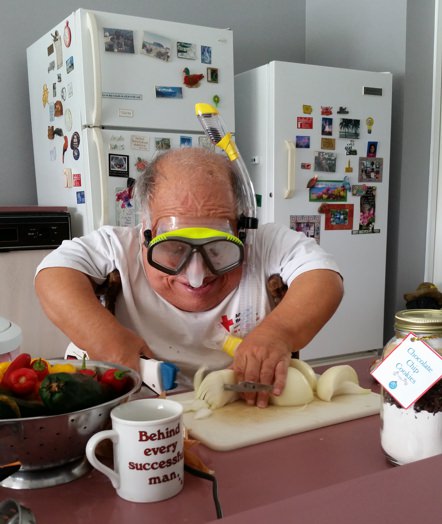
Robert has a trademark trick for avoiding the tears when cutting onions. He wears goggles!

In 1983, I submitted two photos of Robert for the Boston, Massachusetts Little People of America conference brochure—a funny one for the planning committee’s personal pleasure and a serious one for publication. But the committee shared the joke with everyone. In the gallery of national officers, Robert sported a snorkel and goggles in contrast to the formal attire of the other officers.

Talking a mile a minute

The morning after my 2013 Aortic Valve Replacement surgery, I was alert, the intubation tube was out, and I was asking for water and my glasses. When ICU staff sat me up, I was talking a mile a minute. Robert’s sister stopped me because my surgeon was standing at the door. He said I reminded him of his wife and declared Robert a saint.

The stories in this post are edited excerpts from “Pass Me Your Shoes” available on Amazon as an e-book and a 52% discount in print. Read more at https://angelamuirvanetten.com/pass-me-your-shoes/

DWARFISM TRILOGY VALENTINE’S SPECIAL: email me at angela@angelamuirvanetten.com to request all three books autographed—Dwarfs Don’t Live in Doll Houses, Pass Me Your Shoes, and Always an Advocate—for $20, plus $4.00 postage.

Categories
Accessibility

Take Action Against ADA Access Violations

Measure Up

Thirty years after the effective date of the Americans with Disabilities Act (ADA) on January 26, 1992, I didn’t expect to read about an accessibility nightmare. But that’s exactly what a Little Person wrote about her recent experience trying to order fast food from a McDonald’s self-serve kiosk. The menu graphics on the screen were too high for her to click on!

And from there this FaceBook conversation expanded to stores out-of-reach point-of-sale terminals. Commenters reported a store raising the height of all their terminals when it remodeled three years ago and, when asked to lower the terminals, other stores either refused or did nothing despite agreeing to look into it.

Want to subscribe to receive blog updates sign up today!

The need for a store cashier to enter the order or read information on the checkout screen clearly did not compensate for the loss of independent use of the equipment.

Instead of fuming about ongoing access denials and being unwilling to accept the status quo, group commenters shifted gears into problem solving. Why accept what doesn’t need to be? Doesn’t the ADA mandate an accessible height for point-of-sale terminals? How do we find out the required height? Where do we get the documents to print and show store managers?

Being part of this conversation was just the nudge I needed. I had long planned to write about ADA enforcement procedures for public accommodations. And here right in front of me was a group motivated to take action. I provided them with the link to the ADA Standards Adopted by the U.S. Dept. of Justice (2010) and U.S. Dept. of Transportation (2006). Armed with this document the group now knows that an accessible terminal height is no more than 48 inches (ADAAG §§308.2 forward reach, 308.3 side reach, and 309.3 height of operable parts).

A suggestion to carry a tape measure to document the height of these inaccessible screens or terminals was followed by another question. Who do we contact after we measure? In other words, if operable parts on out-of-reach equipment violate the ADA by measuring more than 48 inches and stores refuse to comply, who has authority to enforce the law? The answer lies in ADA Title III regulations 28 CFR §§36.501 to 36.503 which gives authority to both the person subjected to disability discrimination and the U.S. Dept. of Justice (DOJ).

The individual can either make an official complaint to the DOJ (see instructions at https://www.ada.gov/filing_complaint.htm#1) or file a private lawsuit against the store. However, given the large volume of ADA complaints from people throughout the United States, a DOJ review can take up to three months.

Alternatively, the DOJ can investigate a complaint, intervene in an individual’s private lawsuit in cases of general public importance, or initiate a compliance review. Settlement negotiations are often used to resolve disputes. In appropriate cases, the United States Attorney General may file a lawsuit in federal court and obtain civil penalties of up to $55,000 for the first violation and $110,000 for any subsequent violation.

So are you ready to challenge the access violations that limit your independence?

To dig deeper, read ADA Accessibility Standards at https://www.access-board.gov/ada/ and ADA Title III regulations at https://www.ada.gov/regs2010/titleIII_2010/titleIII_2010_regulations.htm.

For history on how Little People of America led the charge to lower the unobstructed side-reach standard from 54 to 48 inches in federal and state law, read Chapter 15, Breaking the Six-Inch Reach Barrier, in “ALWAYS AN ADVOCATE: Champions of Change for People with Dwarfism and Disabilities.” Print, audio and e-books are available at https://www.amazon.com/dp/1737333600/.

Categories
Disability Rights

End Disability as Reason to Terminate Pregnancy

unborn

“This is one that should never have been born! whispered the Director of Nursing on August 3, 1953.” This opening line in Dwarfs Don’t Live in Doll Houses, the first memoir book in my dwarfism trilogy, illustrated the prevailing view of people towards babies born with disabilities, especially infants like me who were expected to die. Thankfully my birth preceded prenatal testing and a mother’s choice to terminate a pregnancy based on disability. I was born alive and successfully fought for the life God gave me.

Want to subscribe to receive blog updates sign up today!

Fast forward 68 years and the negative attitude towards disability births persists. The difference is that today prenatal test results can alert an expectant mother of her baby’s disability in the second or third trimester. And eugenics laws allow a mother to have a late-term abortion.

Estimates of how many pre-born children are terminated by reason of their disability range from 0.59% to 3%. Based on U.S. Center for Disease Control data of 629,898 legal induced abortions in 2019, this adds up to terminations of anywhere from 3,716 to 18,897 disabled babies per year. This many deaths for any other reason would count as a catastrophe warranting annual vigils and memorials of a 911 caliber. Instead a pre-born child celebrated at a baby shower one week is dehumanized and discarded as fetal refuse the next week.

Nonetheless there is good news on two fronts of a prenatal disability diagnosis. First, many mothers continue their pregnancy. For example, one couple attended a Little People of America (LPA) meeting to better understand what life would be like for their pre-born son diagnosed with dwarfism. LPA encouraged them at the meeting and maternity hospital after their son was born.

Second, between 2019 and 2021, several states banned abortions by reason of disability:

  • Arizona, Kentucky, and Mississippi prohibited abortions because of genetic abnormality.
  • Arkansas, Indiana, Kentucky, Missouri, North Dakota, Ohio, South Dakota, Tennessee and Utah specifically called out Down Syndrome (Ds) as an unlawful reason for an abortion given a U.S. abortion rate of about 67% for Ds.

Although some courts have blocked these bans from going into effect, the final outcome could depend on the Supreme Court of the United States (SCOTUS) decision in Dobbs vs. Jackson Women’s Health Organization expected in or about June 2022.

Hailed as the most important abortion case in 30 years, Dobbs gives SCOTUS the opportunity to overturn Roe v. Wade (1973) and Planned Parenthood v. Casey (1992) which preclude a state’s interference with a woman’s choice to have an abortion prior to viability (about 24 weeks). The State of Mississippi law prohibiting abortion after the 15th week of pregnancy, except in cases of medical emergency or severe fetal abnormality, is a direct challenge to Roe v. Wade. When lower courts in Dobbs found the Mississippi law unconstitutional, SCOTUS accepted Mississippi’s petition for review.

So what can we do to preserve the lives of pre-born babies with a disability? Pray that SCOTUS justices will have the courage to override Roe v. Wade!

For information on subscribing to my weekly blog and ordering books in my dwarfism trilogy, go to https://angelamuirvanetten.com.

Categories
Disability Rights Medical

Is Long COVID A Disability Under Civil Rights Laws?

Long-Haul COVID

Two years after COVID-19 was first detected, the global pandemic has infected more than 300 million people, claimed the lives of almost 5.5 million, and changed the lives of everyone.

Much has been learned about the virus, but so much more remains a mystery. Surprisingly, Long COVID (also called post-acute COVID-19 or chronic COVID) has emerged as a disease with a wide range of new, returning or ongoing health problems experienced more than four weeks after the first COVID-19 infection. Even asymptomatic people can later present with Long COVID.

Want to subscribe to receive blog updates sign up today!

Dr. Devant Sanghavi, a critical care medicine specialist, breaks out Long COVID into three categories of symptoms: (1) direct cell damage preventing full recovery; (2) chronic hospitalization due to being in the hospital, ICU, or bedridden for weeks; and (3) post recovery onset. The five most common symptoms are fatigue, headache, attention disorder (sometimes called “brain fog”), hair loss, and shortness of breath. Other symptoms are related to lung disease (cough, chest discomfort, sleep apnea, pulmonary fibrosis), cardiovascular (arrhythmias, myocarditis), and neurological (dementia, depression, anxiety, obsessive-compulsive disorders).

In light of the rise of Long COVID as a significant health issue, the United States Office for Civil Rights of the Department of Health and Human Services (HHS) and the Civil Rights Division of the Department of Justice (DOJ) published a joint guidance in July 2021. The guidance explained that Long COVID can be a disability under the Americans with Disabilities Act (ADA), Section 504 of the Rehabilitation Act, and Section 1557 of the Affordable Care Act if it substantially limits one or more major life activities. It also recognized Long COVID as a physical or mental impairment based on a physiological condition affecting one or more body systems given the damage it causes to multiple organs including the heart, lungs, kidneys, skin, and brain.

The guidance found that a person with Long COVID can be substantially limited in the following major life activities:

  • Respiratory function due to shortness of breath, fatigue, and related effects.
  • Gastrointestinal function due to intestinal pain, vomiting, and nausea.
  • Brain function, concentrating, and/or thinking.

Consequently, people whose Long COVID qualifies as a disability are entitled to the same protections from discrimination as any other person with a disability under the ADA, Section 504, and Section 1557; they are entitled to full and equal opportunities to participate in and enjoy all aspects of civic and commercial life. This means that businesses or state or local governments will sometimes need to make changes to the way they operate to accommodate a person’s Long COVID limitations, such as:

  • Providing additional time on a test for a student who has difficulty concentrating.
  • Modifying procedures so a customer who is too tired to stand in line can announce their presence and sit down without losing their place in line.
  • Providing refueling assistance at a gas station for a customer whose joint or muscle pain prevents them from pumping their own gas.

Stay tuned for further research results on the prevalence and longevity of this condition.

This post was partially informed by the United States HHS and DOJ joint guidance on Long COVID published at https://www.hhs.gov/civil-rights/for-providers/civil-rights-covid19/index.html and https://www.ada.gov/long_covid_joint_guidance.pdf.

For information on subscribing to my blog and ordering books in my dwarfism trilogy, go to https://angelamuirvanetten.com.

Categories
Disability Rights

What Happens When the Supreme Court of the U.S. Gets It Wrong?

Supreme Court

When Congress enacted the Americans with Disabilities Act (ADA) in 1990 they adopted the same definition of disability used in the Rehabilitation Act of 1973. They expected that courts would follow Rehabilitation Act caselaw when deciding who is disabled. Shockingly this did not happen. Instead courts narrowly interpreted the disability definition leaving many ADA claimants without justice.

As a result, discrimination against people with attention deficit hyperactivity disorder, bipolar disorder, blood cancer, major depression, diabetes, epilepsy, learning disabilities, multiple sclerosis, and sleep apnea went unchecked.

Want to subscribe to receive blog updates sign up today!

A diabetic could be denied coverage due to the mitigating measure of taking insulin leading to the absurd result that an employer could refuse an accommodation request to take a break to administer insulin because the employee was not disabled!

The Supreme Court of the United States (SCOTUS) cemented this trend in two chilling cases. In Sutton v. United Air Lines, Inc., 527 U.S. 471 (1999), severely myopic twin sisters with uncorrected visual acuity of 20/200 were counted as nondisabled because their vision could be corrected with eyeglasses and contact lenses. In Toyota Motor Manufacturing, Kentucky, Inc. v. Williams, 534 U.S. 184 (2002) an employee with carpal tunnel syndrome was denied relief even though she was unable to perform manual tasks associated with her specific job. In creating a demanding standard to show disability, SCOTUS required the employee to be unable to perform tasks central to most people’s daily lives.

So how do we push back against SCOTUS decisions that allow disability discrimination to run rampant? It took several years, but Congress finally took action to reject Sutton and Toyota Motor Manufacturing, Kentucky rulings. Effective on January 1, 2009, the ADA Amendments Act of 2008 (ADAAA) reinstated a broad scope of protection for people with disabilities and made it easier for them to prove disability within the meaning of the ADA.

The ADAAA and implementing regulations retained the ADA’s basic definition of disability as an impairment that substantially limits one or more major life activities, a record of such an impairment, or being regarded as having such an impairment. However, it changed how these statutory terms should be interpreted:

  • An impairment that substantially limits one major life activity need not limit other major life activities in order to be considered a disability and is a lower threshold than “prevents” or “severely or significantly restricts.”
  • The definition of “major life activities” was expanded to include two non-exhaustive lists and is not determined by reference to whether it is of “central importance to daily life.”
  • Mitigating measures that eliminate or reduce the symptoms or impact of an impairment shall not be considered in assessing whether an individual has a disability with the exception of “ordinary eyeglasses or contact lenses.”
  • An impairment that is episodic or in remission is a disability if it would substantially limit a major life activity when active.

Congress corrective action put the ADA back on track and reminds us not to give up when courts take a wrong turn.

For additional information on the ADAAA, go to https://www.eeoc.gov/statutes/americans-disabilities-act-amendments-act-2008

For information on my books and blog, go to https://angelamuirvanetten.com.