Categories
Celebrations Little People of America

Celebrate Authors with Dwarfism on World Book Day

World book day

Reduce stress. Improve memory and brain function. Increase attention span. Discover a link between the past and the future, a bridge between generations, and across cultures. Contribute to social transformation. You can do it all by reading books.

For 25 years, the value of reading books has been celebrated on April 23, the anniversary of the deaths of authors William Shakespeare of England, Miguel de Cervantes of Spain, and Inca Garcilaso de la Vega of Peru. The United Nations Educational, Scientific and Cultural Organization inaugurated World Book Day to promote the enjoyment of books and reading.

Want to subscribe to receive blog updates sign up today!

In the words of some writers:

“There are worse crimes than burning books. One of them is not reading them.” ~ Joseph Brodsky

“Reading is an exercise in empathy; an exercise in walking in someone else’s shoes for a while.” ~ Malorie Blackman

“Books can be dangerous. The best ones should be labeled ‘This could change your life’.” ~ Helen Exley

“Reading is to the mind what exercise is to the body.” ~ Joseph Addison

“Books help us understand who we are and how we are to behave. They show us what community and friendship mean; they show us how to live and die.” ~ Anne Lamott

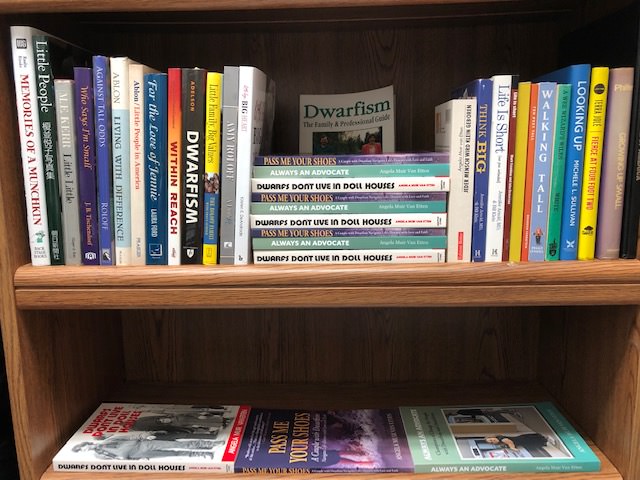
So are you ready to reduce stress, prevent crime, increase empathy, flirt with danger, exercise your mind, and learn how to live? If yes, I recommend you start by reading recent books authored by people with dwarfism:

“ALWAYS AN ADVOCATE: Champions of Change for People with Dwarfism and Disabilities,” Angela Muir Van Etten, 2021.

“Dwarfs Don’t Live in Doll Houses,” Angela Muir Van Etten, Kindle 2021.

“PASS ME YOUR SHOES: A Couple with Dwarfism Navigates Life’s Detours with Love and Faith,” Angela Muir Van Etten, 2020.

“Dwarfism, Spatiality and Disabling Experiences” (Interdisciplinary Disability Studies), Erin Pritchard, 2020.

“Looking Up: How a Different Perspective Turns Obstacles into Advantages,” Michele L. Sullivan, 2020.

“A Little Me,” Amy Roloff, 2019.

“LITTLE LEGS, BIG HEART: One Girl’s Journey of Acceptance, Perseverance, and Growth,” Kristen DeAndrade, 2019.

“TEN FEET TALL: Step Into Your Truth and Change Your Freaking World,” Brandon Farbstein, 2018.

“Fierce at Four Foot Two,” Terra Jolé, 2017.

“THINK BIG: Overcoming Obstacles with Optimism,” Jennifer Arnold MD and Bill Klein, 2017.

“LIFE IS SHORT (No Pun Intended): Love, Laughter, and Learning to Enjoy Every Moment,” Jennifer Arnold MD and Bill Klein, 2016.

All books are available on Amazon.com and at various other book retailers.

In the tradition of World Book Day, get your free paperback and autographed copy of the out-of-print Dwarfs Don’t Live in Doll Houses from the recently discovered box of books in my sister’s basement in Sydney, Australia. Qualify for the free book and free shipping by completing your dwarfism trilogy paperback set with a 33% discount on Pass Me Your Shoes and/or Always an Advocate at $10 per book. Email angela@angelamuirvanetten.com so we can exchange mailing addresses.

Need specific information on the merits of each book? Go to https://angelamuirvanetten.com/books/.

Categories
Motivation

Reach As High As You Can

Reach for the Stars

The greatest danger for most of us is not that our aim is too high and we miss it, but that it is too low and we reach it. ~ Michelangelo, artist, poet, and architect.

Billy Barty never learned to be small. He often said ‘To be BIG you must think BIG’ and he did. ~ Wesley Morse, brother-in-law of the three-feet-nine-inch tall actor and founder of Little People of America.

April 14, National Reach As High As You Can Day, is a day to reach for our dreams, aim high, or think big. Aspirational for everyone, but essential for people with dwarfism whose reach limitations touch every aspect of life. But first we must identify what we can’t do! Yes, you read that right. And here’s what I mean.

Want to subscribe to receive blog updates sign up today!

  1. I can’t do everything, but I can do anything I want because my wants are filtered by a realistic understanding of my abilities. For example, not being able to kneel, run, or solve math problems stopped me from wanting things I can’t do. My inability to kneel ruled out pining for a plumber’s license; not being able to run suppressed my race to track athletics; and my inability to solve math problems stifled any urge to fly to the space station.
  2. I can’t accept limitations others impose on me. The uninformed may say, you can’t do that. Little do they know how motivating this is. Proving it can be done, spurs me on to show how wrong they are.
  3. I can’t do some things the same way as other people, but I can do those things differently. For example, I wash my hands in an inaccessible public bathroom by using the hand sanitizer I carry in my handbag; I reach items off a high shelf with a reacher; and I ‘walk’ distances riding a mobility scooter.
  4. I can’t believe the derogatory things people say about me. Whenever anyone has offended me, I try to raise my soul so high that the offense cannot reach it. Rene Descartes.
  5. I can’t always accept the status quo. For example, advocacy is needed to change inaccessible buildings and facilities like ATMs, elevator buttons, and self-serve gas pumps. Always remember, you have within you the strength, the patience, and the passion to reach for the stars to change the world. ~ Harriet Tubman, escaped slave and ‘Moses of her people’ in the Underground Railroad.
  6. I can’t accept discrimination. Being rejected because of my size is a barrier to knock down or bypass.
  7. I can’t always make it by myself. I may need help with some things, like opening a heavy door, reaching something, or changing a light bulb. And I’m okay with receiving help and giving help to others; it makes for a better world.

Finally, I can’t wait to see how aiming high leads you to achieve your goals. If you aim higher than you expect, you could reach higher than you dreamed. Sir Richard Branson, billionaire entrepreneur and adventurer.

For discussion of diverse disability issues, follow Top 100 Disability Blogs and Websites at https://blog.feedspot.com/disability_blogs/ and my Monday blog posted on feedspot.com and https://angelamuirvanetten.com/blog/.

Categories
Guest

Shining a Light on Crime Victims with Disabilities

Photo Credit: Claudia Wolff

During the month of April, Sexual Assault Awareness Month, Child Abuse Prevention Month, and National Crime Victims’ Rights Week is recognized. As a nonprofit that provides services to people with disabilities, including victims of crime, Coalition for Independent Living Options (CILO) appreciates the attention April brings to these important issues.

People with disabilities are exceptionally vulnerable to being sexually assaulted or abused as children. According to the Vera Institute of Justice, people with disabilities are three times more likely to be sexually abused as children. The disability types with a heightened risk include intellectual, communication, and behavior-related disabilities.

Want to subscribe to receive blog updates sign up today!

Those who rely on a caregiver are at risk of sexual assault and abuse at the hands of those they trust. Abusive caregivers may downplay the abuse, attempting to justify their actions as “necessary” or as a normal part of the caretaking process. Often the abuse goes unreported as the victim fears retaliation, may not want to get the caregiver in trouble, or may fear losing their independence if the caregiver is removed.

Unfortunately, society as a whole does not typically recognize those with disabilities, especially youth with disabilities, as sexual beings. This results in youth with disabilities being left out of important conversations surrounding consent, sexual education, and healthy relationships. Without a strong foundational understanding of their rights over their own body, youth with disabilities may be targeted by others who assume they are less likely to be viewed as credible.

Male-identified individuals are also at risk for sexual assault and child abuse. According to one study, the prevalence of lifetime sexual violence was 13.9% among men with a disability, as compared to 3.7% of men without a disability.

Awareness surrounding the issues of child abuse and sexual assault of people with disabilities is critical. Often people with disabilities don’t recognize that they are experiencing abuse. In many cases, community members and service providers identify and report the suspected abuse. Increased education to law enforcement about crime victims with disabilities is vital. There is a misconception among first responders that people with disabilities, especially those with cognitive or intellectual/developmental disabilities, lack full understanding of what took place, or do not have accurate recall of events. Law enforcement may not investigate or push cases forward for prosecution for these reasons. Likewise prosecutors may consider the person lacking credibility and choose not to file charges.

Equally important to awareness is ensuring access to much needed services and resources. Those enduring abuse may be unaware of resources available in the community, or may encounter barriers in accessing those resources. For example, those with communication disabilities may not be able to clearly explain their experience or may use assistive technology that listeners unfamiliar with the device have difficulty understanding.

This April, take time to learn more about the impacts of crime on those with disabilities.

If you, or someone you know, is a crime victim in need of services, contact your local law enforcement agency and ask for a referral to a victim advocate that works exclusively with people with disabilities.

Statistics in this post are drawn from the Vera Institute of Justice, https://www.vera.org/publications/sexual-abuse-of-children-with-disabilities-a-national-snapshot and the Building Partnerships Initiative for the Protection of Persons with Disabilities, https://mabuildingpartnershipsinitiative.com/resources/prevalance-of-violence/.

This post first appeared on Angela Muir Van Etten’s blog on April 4, 2022 at https://angelamuirvanetten.com/. Sharing is encouraged.

Categories
Accessibility Medical

Tackling Inaccessible Medical Equipment, Part II

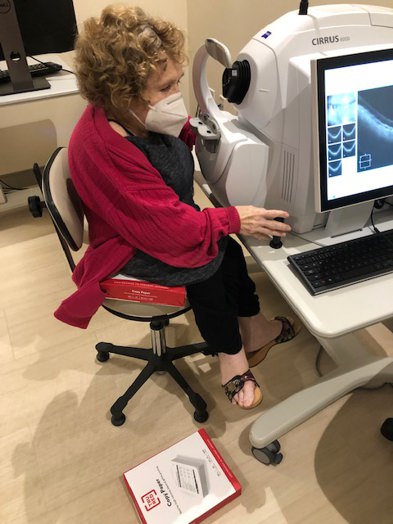
Cirrus DME

My first post on inaccessible medical equipment was April 19, 2021 before and after cataract surgery. Lamentably, a subsequent diagnosis of a hole in the macular mandated surgery and further access to diagnostic eye equipment. Once again, I was confronted by equipment incompatible with my height of three feet four inches.

Although two reams of copy paper enabled me to mount a chair in front of an eye scanner, I was still short of the chin rest. One imaging technician, citing rules against lifting me, suggested skipping the scan. Too bad that this would leave the surgeon without critical information for diagnostic decisions! Clearly, this was not an option.

Want to subscribe to receive blog updates sign up today!

All I needed was another couple of inches. So I asked the technician to get another ream of paper. She complied because she had no idea what to do. I leaned left raising my right buttock cheek off the seat and had the technician slide the third ream under this side of my butt. After placing my right cheek on the ream, I asked her to push it to the other side of the chair while I scooted my left cheek onto the ream. And voilà, my torso was raised within reach of the chin rest, and the surgeon got his scan.

My annual cardiology check of my Top Hat mechanical aortic valve is also an occasion for confronting access barriers. Although the electrocardiogram (EKG) and echocardiogram equipment are accessible, the examination table is not. The technologist told me that the office did not have an accessible table because it cost $5,000 compared to the $1,500 for a regular table. The accountants won.

As a result, I declined to climb onto the exam table for the EKG and had the test while seated in a chair. The echo was a different story. Although it could be done with me seated, the result would be more accurate if I lay on the table. Here I surrendered my independence and, with assistance, climbed onto a stool then a chair and up to the table.

I’m only one of thousands, possibly millions, of people with disabilities being denied independent access to medical diagnostic equipment (MDE). So where do we go to file a discrimination complaint? The answer is NOWHERE.

Although the Architectural and Transportation Barriers Compliance Board (Access Board) technical criteria for medical diagnostic equipment (MDE Appendix to 36 CFR Part 1195) was due to expire in February 2022, the rule was extended for three years. The Board sought additional time to complete research on low transfer heights. However, the MDE rule remains unenforceable under the Americans with Disabilities Act (ADA) or Rehabilitation Act because it has not been adopted by the United States Departments of Justice (DOJ) and Health and Human Services (HHS).

So instead of filing a complaint, advocate for the Access Board to expedite the research so that accessible MDE can be mandated by enforcement agencies. And share your experiences on inaccessible MDE with Attorney Advisor Wendy Marshall, (202) 272-0043, marshall@access-board.gov.

For further reading, see Standards for Accessible MDE. A Rule by the Access Board. February 3, 2022. https://www.federalregister.gov/documents/2022/02/03/2022-02133/standards-for-accessible-medical-diagnostic-equipment For discussion of diverse disability issues, follow Top 100 Disability Blogs and Websites at https://blog.feedspot.com/disability_blogs/ You can follow my blog on feedspot or at my website, https://angelamuirvanetten.com.

Categories
Etiquette

Renounce Common Discourtesy, PLEASE

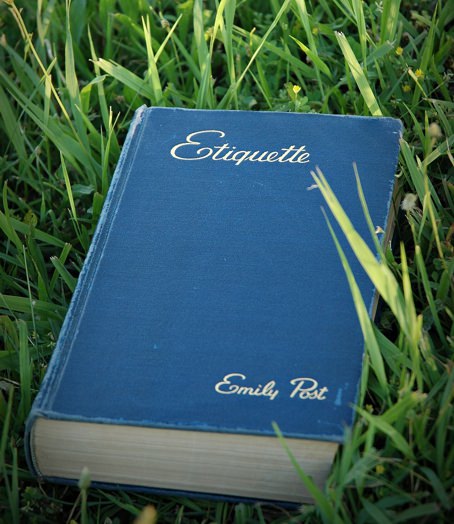
book

As much as it annoys me when people forget to say “please” and “thank you,” today I ask people to use common courtesy when encountering someone with dwarfism or another disability. So in honor of March 21st, National Common Courtesy Day, please renounce the following common discourtesies, today and always.

1. Staring or Finger Pointing

An overwhelming majority of people with dwarfism suffer from strangers pointing fingers and piercing eyes that won’t let go of their gaze. The sight of someone so short is more than they can handle politely. This unsolicited attention is not only rude, but also can discourage people from going out in public and makes us uncomfortable when we do venture out.

Want to subscribe to receive blog updates sign up today!

2. Ridiculing

Recently, a Paralympic swimmer from Great Britain made headlines when he said he was “sick to death” of being laughed at on the street because of his dwarfism. When he spoke out against the ridicule he had been subjected to his whole life, he tapped into a ground swell of public support for his inclusion and respect. His experience resonates with many people of short stature engaged in the same fight.

3. Touching

According to one study, one third of people with dwarfism have been physically touched by strangers in public. We have been patted on the head for good luck, to see if we are real, or in the manner used to greet a child. Some even try to pick us up without permission. This is both discourteous and dangerous. So don’t even think about it.

4. Spacing

Invading personal space is incredibly disrespectful. However, it’s not uncommon for people to discount my presence and encroach on the space immediately above my head. They might reach over my head to shake hands with someone in front of me or to get food from a buffet table beside me. The drip from a spoon passing overhead adds insult to injury.

During COVID-19 restrictions, physical distancing was recommended. But it’s both obnoxious and reprehensible when the noncompliant close the gap and put those unable to be vaccinated at high risk for infection. Although restrictions have been lifted in many places, COVID is still killing people. So please step back when asked to do so.

5. Talking

Researchers have reported that three-quarters of people with dwarfism have been verbally abused. Names like hunchback, midget, runt, stumpy and dolly are derogatory, demeaning, and worthy of disdain. Delete them from your list of adjectives for little people. And don’t tolerate it when your friends use such crass vocabulary.

6. Filming or Photographing

The “take a picture it lasts longer” retort to someone staring at you is risky. The person could whip out their cell phone, snap a photo, or take a video. Many take pictures of us when they think we’re not looking. This alarming trend is exacerbated by fears that the photos will appear on social media hate sites or as trophies on personal pages. Don’t click and definitely don’t post.

Thanks in advance for exercising common courtesy.

For further discussion, read “Dwarfs Don’t Live in Doll Houses,” https://angelamuirvanetten.com/dwarfs-dont-live-in-doll-houses/ chapter 3, Educated; chapter 6, Attitudes Disable; and chapter 9, Attention Gives Opportunity.

Categories
Inclusion

Inclusion via Audiobooks

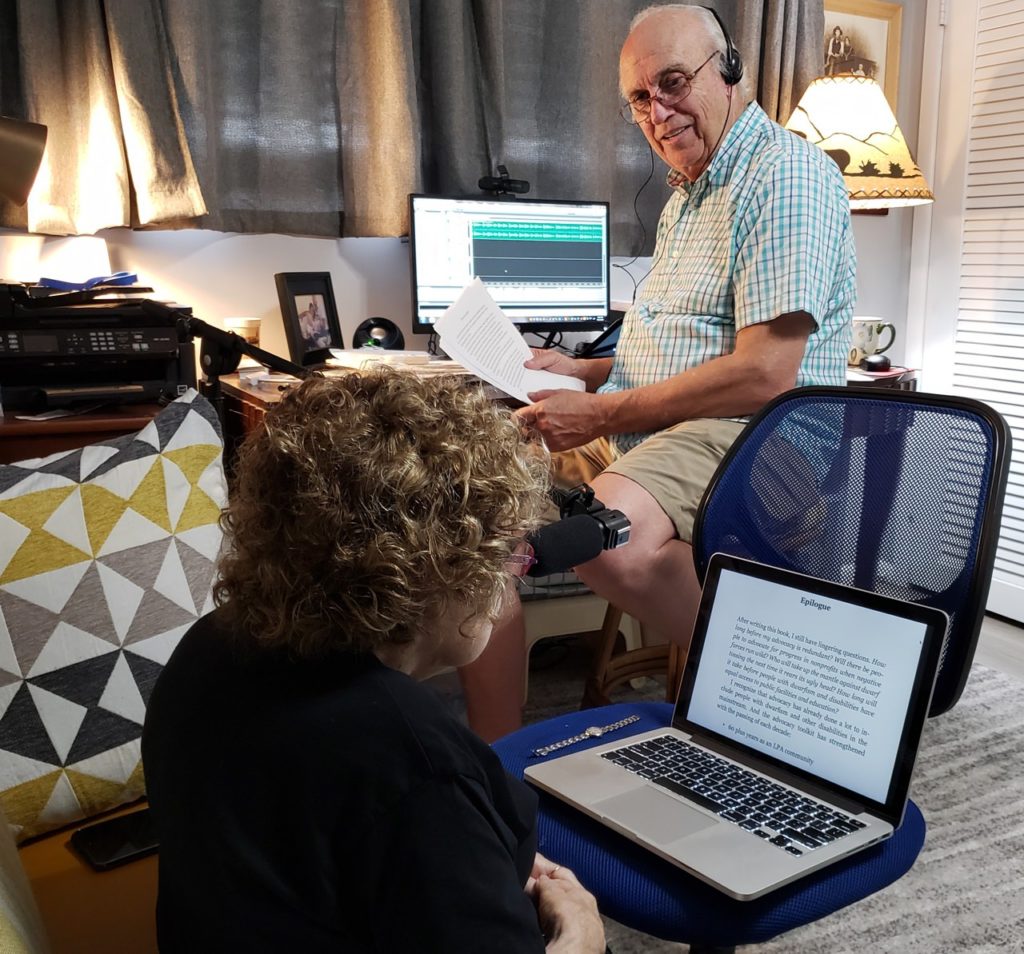
Recording Session
Production engineer, Barry Marsh wearing headphones and glasses, sits in front of his computer screen which displays recording sound waves. He is looking at the author and narrator, Angela Van Etten, who is seated next to him facing her laptop screen which displays the Epilogue. Angela reads out loud from the screen using the microphone in front of her. Barry listens carefully for voice clarity, expression, pace, and recording quality.

My first introduction to talking books was as a child listening to books with my great grandmother. Her vision loss qualified her for the Royal New Zealand Foundation of the Blind talking book service. So when I authored Dwarfs Don’t Live in Doll Houses in 1988, I naturally gave permission to the Library of Congress to read the book for their talking book library service.

Fast forward 34 years to a marketplace that lets all readers listen to books using mobile phones, tablets, and computers. Access to audiobooks is no longer limited to people with vision impairments and audiobooks are commercially available to everyone (except those with a hearing impairment).

Want to subscribe to receive blog updates sign up today!

People with various disabilities—vision, brain, neurological, cognitive—have access to books without using their eyes to read, hands to turn pages, or mind to process written words. They are included among readers who listen to audiobooks for entertainment, relaxation, escape, and learning new things. And they listen while commuting, doing housework, exercising, and walking, among other things.

Because audiobooks are the fastest growing segment in publishing, I had two reasons for releasing Always an Advocate: Champions of Change for People with Dwarfism and Disabilities in the audiobook format—inclusion of people with disabilities and market demand.

Partnership with my friend Barry Grant Marsh, a veteran broadcaster and advertising marketing executive, made this possible. Under Barry’s tutelage, I followed the path of many nonfiction authors and narrated the book myself.

After laboring together for many months, Barry and I are thrilled to announce the publication of Always an Advocate as an audiobook. We persevered through technical challenges, medical interruptions, and learning curve issues. But with God’s help we succeeded in bringing you the opportunity to listen to this book which is endorsed by many in the disability community:

“And when a righteous voice needs to be amplified, Angela rose to the challenge time and time again. Her seemingly endless supply of energy comes from her faith in God and her love of the underdog.” ~ Bill Klein, Co-Star of TLC’s Little Couple

“Be inspired and encouraged by Angela’s determination to take on all challenges, and eventually overcome and master them with an ample dose of faith and humor.” ~ Genevieve Cousminer, Esq., former Director of the Coalition for Independent Living Options

“You will learn a lot about the challenges that dwarfs face in their everyday lives — and about the life and activism of this remarkable woman.” ~ Dan Kennedy, Author of Little People: Learning to See the World Through My Daughter’s Eyes

“I am proud to be in the same company as Angela Van Etten [who] contributed in countless ways to the advancement of the dwarfism community, the disability community, and the broader community.” ~ Gary Arnold, LPA Past President

“This book offers the reader a grand tour of local, state, and federal opportunities for advocacy. The only requirement is passion, dedication, a thick skin, patience, and a sense of humor.” ~ Jim Kay, LPA Historian

The Always An Advocate audiobook is available on Amazon, Audible, and iTunes. Click on the link for more information, https://angelamuirvanetten.com/always-an-advocate/, listen to a retail sample, and get your copy today.

And One More Thing: If you’d like to receive a promo code for a free copy in exchange for a fair and honest book review, please email me at angela@angelamuirvanetten.com.

Categories
International

Remember Ukrainians with Disabilities

ukraine flag dove

Invasion. Call to arms. Mass exodus. Air raid sirens. War crimes. Nuclear war threat. None of this crossed my mind when planning today’s blog post. But unprovoked Russian aggression against Ukraine compelled me to write about the greatest unleashing of evil since World War II.

Horrific scenes in the hourly news cycles are hard enough to bear, but are only a glimpse of the horror. The agony imposed on the estimated 2.7 million people with disabilities is unimaginable.

Want to subscribe to receive blog updates sign up today!

  • How many will die due to medical facilities—once used for treating life threatening conditions like cancer, organ failure, and COVID-19—being converted to emergency care for the injured?
  • How many will die due to starvation and unavailability of medications?
  • How are people with intellectual or mental health impairments coping with the trauma?
  • How do wheelchair users exit high rise buildings when power outages shut down elevators and how do they get downstairs into basements and bomb shelters?
  • How do those using power wheelchairs and respiratory equipment charge their batteries?
  • Who will pay for wheelchair accessible vehicles to transport their users to safety across the border?
  • Who will help the tens of thousands of children with disabilities living in orphanages and institutions?
  • How do people needing personal care services find a replacement for a caregiver who has evacuated the country?
  • Where will refugees needing accessible accommodation find shelter?
  • How many will acquire disabilities as a result of the war?

Sanctions, military supplies, solidarity and support have come from world leaders, cities, charities, and individual citizens. Flying the Ukrainian flag and sunflower displays are laudable, but do nothing to help civilians fleeing with their children and pets and “farewelling” loved ones who must stay behind to fight. So what can we do?

First and foremost we can pray for God’s intervention—He can make the impossible happen. History attests to this. In ancient times, the Israelites often defeated enemies with greater military strength. Well known examples include the defeat of Egypt led by Moses (Exodus 14), Midian led by Gideon (Judges 7), and Jericho led by Joshua (Joshua 6). Modern day examples include national days of prayer and fasting during World War II when British soldiers were trapped at Dunkirk, Hitler planned to invade Britain, and prior to D-Day.

Today as Ukraine confronts an enemy more powerful and numerous, let’s pray for God to hear their cry and intervene on their behalf. May God give President Zelensky and the Ukrainian people courage and confidence to fight under His command.

            Second we can give to charities with an established track record of working in Ukraine for people with disabilities. On this front, I support Joni and Friends International Disability Center. A regional in-country coordinator and her team have already proved their effectiveness by boldly evacuating 35 people with severe disabilities and their families and caregivers across the border into Poland. As they plan more rescues, they seek our prayers and ask us not to forget Ukrainians with disabilities.

Categories
Celebrations Education

So Where Do You Wear A White Horse Hair Wig?

New Zealand bar admission with Nana & Dad
Angela stands at elbow height of her father and grandmother standing behind her. All three are formally dressed: Angela in a black robe, white collar, and white horse hair wig; Nana in a pink dress, white cardigan and white necklace; and dad in a blue suit and tie with a camera strap draped over his shoulder.

My presence in a bar has been challenged more than once, but exchange the bouncer for the bailiff and you’ll find me unchallenged at the bar of the local court. Eligibility for this bar is based on a certificate of admission to the High Court of New Zealand not a certificate of birth.

On the first day of February 1977, the order of admission was made by the presiding judge. Indeed, the day actually carried an air of fantasy. It began with a parallel to “Goldilocks and the Three Bears.” I felt like big daddy bear robbed of chair, porridge, and bed. When I came to sign the Roll of Barristers and Solicitors, somebody had signed on the line reserved for my name.

Want to subscribe to receive blog updates sign up today?

In all the excitement, one of my peers had signed her name in my space. There was nowhere for me to sign.

The story took a different turn when the Deputy Registrar stepped into the picture. As though a fairy godmother waving her wand, she took out an eraser and removed all traces of the error. With it she also wiped out any suggestions of fantasy. In reality, I was standing there at age 23 ready to enter my name on the roll and to begin my career as a Barrister and Solicitor in law.

Note: In 1977 it was customary for New Zealanders to qualify as an attorney at about age 23, as students entered the four-year law degree program at age 18, without being required to complete an undergraduate degree. However, a first year of general studies, known as pre-law, had to be successfully completed before a decision as to law school admission was made. A fifth year of part time study, while working as a clerk in a law office, was spent qualifying for admission to the bar.

I stood with pride alongside my fellow classmates also taking the oath of admission. As predicted, only half of those who began the five-year law program stood with us on this day. We were at the end of a long road and were finally entitled to speak before the court.

The occasion called for traditional dress—a white horse hair wig and an expensively pleated heavy black legal robe. I couldn’t help thinking how much we all looked like over-dressed penguins, but the apparel was a prerequisite to appearance and the right to speak as counsel in court. It was no time to voice objections. Instead we all robed meekly and took the oath put to us. We hoped other people understood that appearances aren’t the most important thing in the world.

That hope was put to a severe test when I discovered that prospective employers were very interested in appearances. This post is excerpted from Chapter 3, At the Bar, in “Dwarfs Don’t Live in Doll Houses,” the first book in my dwarfism memoir trilogy covering my first quarter century. Click on the link to read what others say about the book and find out where to get your copy: https://angelamuirvanetten.com/dwarfs-dont-live-in-doll-houses/.

Categories
God's protection

Navigating February Blizzards

Blizzard

Within two weeks of our first time attending the Second Presbyterian Church, Reverend Smart made an unannounced home visit. We were shocked because this was February 1983—when almost 23 inches of snow covered the city after the second biggest snowstorm on Baltimore’s record books. But the Reverend walked the half mile from the church to our apartment. It was a safe assumption that he would find us at home. We benefited from the reminder that despite the storms of life, God always shows us a way through. Just like He did in February 1984 when I took the Ohio bar exam in Columbus, three hours south of Cleveland.

Want to subscribe to receive blog updates sign up today!

Because we only had one car, Robert had to drive me to Columbus on the weekend, leave me at a motel near the exam site, and drive back to Cleveland for work on Monday. I awoke on Monday morning to see snow falling—nothing unusual about that in an Ohio winter. However, to wake up on Tuesday—the first of three exam days—and still see snow falling was alarming. I had prepared for the exam with endless hours of study, but had not prepared for a blizzard that dumped about 12 inches of snow. My fear was that my pre-ordered cab would be a no-show. If I did not get to the exam site on time, locked doors would keep me from taking the exam for another six months.

I thanked God when cabs came for me at both the beginning and end of the day. It was a blessing to meet Yvonne and Paula at dinner in the restaurant across the street from the motel. They recognized me from the exam site and invited me to join them.

I would never have made it back to the motel without their help. They held onto me—one on each side—to stop me slipping and sliding in the snow and ice. When blocked by a wall of snow left in the wake of a snow plow at the motel driveway, a motel employee shoveled the snow and helped lift me over the snow bank. Preparing for such obstacles was not in the bar review material.

It was definitely a God-ordained bonding experience with Yvonne and Paula. The three of us teamed up for the next two days for ongoing support, meals, and rides. Our meal the second night at the Spaghetti Warehouse perked up our spirits and gave us the energy to get through the last grueling exam day.

On May 2, 1984, I woke up at 6:45 a.m. in a cold sweat. It was the day to call in for the bar exam results and I dreamed that I had failed.

When the operator reported excitedly, “You passed!” I was relieved to learn that not all dreams—or nightmares, in this case—come true.

I was just as excited to learn that my bar-exam friends, Paula and Yvonne, had also passed.

This post is a condensed excerpt from chapter 7 in “Pass Me Your Shoes: A Couple with Dwarfism Navigate Life’s Detours with Love and Faith.” Click on the title for a Look inside at the first few chapters, endorsements, Table of Contents, and a wedding photo. Link to retail sites on my website at https://angelamuirvanetten.com/books.

Categories
Relationships

Honeymoon Romance Takes A Dive

Pass Me Your Shoes

Our Oahu leis made of fragrant yellow ilima flowers put us both in the mood for romance, though our ideas of how to achieve this were quite different. I thought it would be romantic to walk back to our hotel along the beach. Bobby preferred to walk on the sidewalk along the main road. As a Floridian, Bobby saw no special attraction in traversing sand and surf, but wanting to please his bride, he agreed.

I was ready to walk barefoot and enjoy the warm water caressing our feet, while Bobby preferred wearing his shoes and socks, suit and tie, in the style of an English gentleman. Thus, he was reluctant to go anywhere near the water because he did not want to get his shoes wet.

Want to subscribe to receive blog updates sign up today!

Again, for the sake of his bride, he not only took off his shoes and socks, but he also walked with me hand-in-hand as the water lapped our feet. He even perked up when the skyline of Waikiki and Diamond Head presented a perfect backdrop for him to photograph me in the sparkling water.

Soon thereafter, romance and perfection took a dive. With the roar of three waves piling one on top of the other, I let go of Bobby’s hand, lifted my dress, and braced for the crashing waves. Regrettably, Bobby anticipated nothing—his first indication of trouble was when he found himself flailing prostrate in the swirling waves and clawing in the sand to resist the undertow threatening to pull him out to sea.

He wondered if I was looking for evidence of his demise when he heard me calling out, “Pass me your shoes! PASS ME YOUR SHOES!”

Of course, it was nothing so sinister. I had withstood the waves by digging my toes deep into the sand, but could do nothing to stop Bobby’s plunge. My first thought was to salvage his shoes since he had been so adamant about not getting them wet.

I helped Bobby to his feet and noticed something far worse than wet shoes—salt water was streaming out of the camera case still hanging around his neck. His camera was ruined. I captured the moment on my cheap camera and titled the picture: Total Trauma. Somehow Bobby’s photo of me on Waikiki Beach survived the salt water—our $200 picture represented the replacement cost of the camera, not the value of the subject matter. This was when I learned that a new camera was a nonnegotiable budget item. I did restrain Bobby from bringing the ruined camera on the plane in a bucket of water to prevent further corrosion.

This post is excerpted from “Pass Me Your Shoes: A Couple with Dwarfism Navigate Life’s Detours with Love and Faith.” Click on the title for a Look inside at the books first few chapters, endorsements, Table of Contents, and a wedding photo. Link to retail sites on my website at https://angelamuirvanetten.com/books.