Categories
Dignity

Florida Bans Dwarf Tossing in Bars

Image by BedexpStock from Pixabay

In 1989, barroom spectacles masqueraded as “sport” when Florida patrons competed for prize money awarded to whoever threw a dwarf the farthest or knocked down the most pins with a dwarf. A willing dwarf served as a human Frisbee when tossed into the air or a bowling ball when strapped onto a skateboard.

I learned about this traveling road show from Little People of America (LPA) advocates in Florida. They called me at my New York residence after reading the dwarf-tossing chapter in my 1988 book, Dwarfs Don’t Live in Doll Houses. My words—“When negotiation and advocacy don’t prompt an appropriate response, legislation will be the only means to avert the action”—had proved prophetic in Florida.

Want to subscribe to receive blog updates sign up today!

The Florida dwarf-tossing contests had thrived on negative publicity for a whole year. Any moves to shut down the contests failed because the promoters took the show on the road before local municipalities could prohibit the practice. Consequently, I agreed that a statewide law to make the offensive activity unlawful was needed.

Florida advocates succeeded in getting state lawmakers in both the house and senate to introduce a bill to ban dwarf tossing in licensed establishments. Although I had a minimal role in getting the Florida bill passed, I helped gain public support by joining Florida advocates as a guest on the Sally Jessy Raphael Show. One of the points I made was that dwarf tossing affects all people with dwarfism because it endorses society’s decision to strip dwarfs of their personhood and subject them to unequal treatment as freak show entertainment and objects of ridicule.

Dr. Cheryl Reid, a member of the LPA Medical Advisory Board, addressed the danger of dwarf tossing. She used an anatomical model to show that the spinal cord of dwarfs with achondroplasia—the most common type of dwarfism—has less room to move through the spinal column and is more likely to be kinked or bent possibly causing sudden paralysis or death. Support for her opinion came from quotes Sally read from other dwarfism doctors at nationally renowned medical centers.

Further medical evidence showed that there was no way to make dwarf tossing safe. Dr. Aldo F. Berti, Clinical Assistant Professor of Neurological Surgery at the University of Miami School of Medicine, wrote, “I do not believe any safety equipment used by the volunteer dwarves in their chosen risky business serves as significant protection since it does not give any stability to their weak musculoskeletal complexion.”

Contrary to the predictions of Florida dwarf-tossing promoters, the Florida bill became law on June 28, 1989!

According to Nancy Mayeux, the mother of two girls with dwarfism, the legislature found that dwarf tossing

  1. is morally wrong;
  2. creates discrimination against dwarfs;
  3. is a potential financial burden to the State when inevitable injury occurs to the uninsurable dwarf who is tossed;
  4. infringes on the rights of, and endangers, other dwarfs in the community threatened by tossing against their will; and
  5. is an embarrassment to the State.

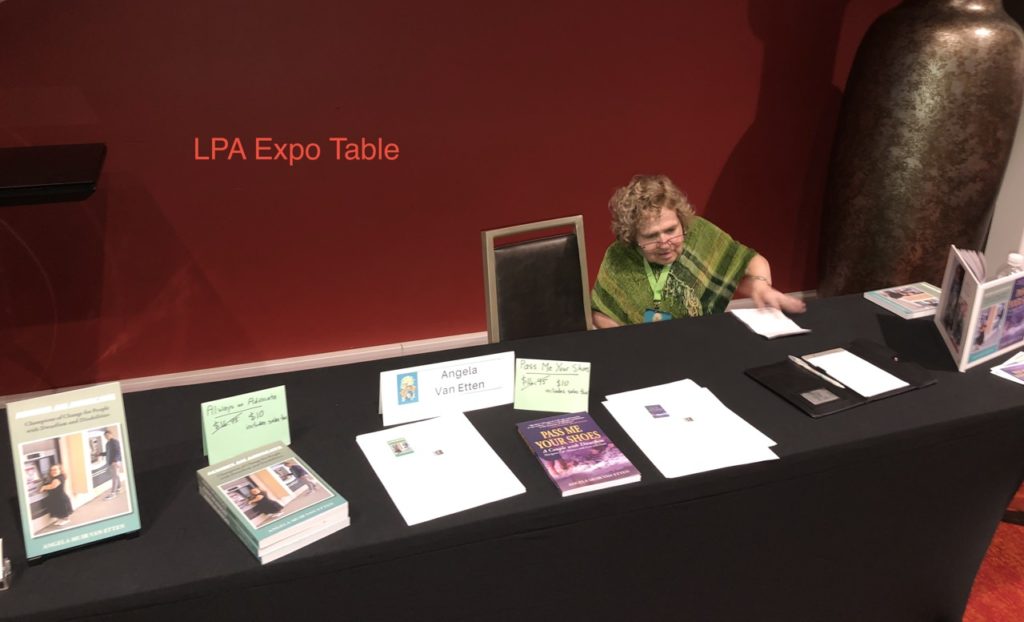
This post is excerpted from Part II, The Rise and Fall of Dwarf Tossing, in “ALWAYS AN ADVOCATE: Champions of Change for People with Dwarfism and Disabilities” available on Amazon in print, e-book, and audio formats. Read more at https://angelamuirvanetten.com/always-an-advocate/.

Amazon book review excerpts re dwarf tossing:

“Perhaps the most inspiring section is the campaign run by Little People of America to ban ‘dwarf tossing’ in bars in Florida and New York. Angela was very much involved in this campaign, her legal background proving a major asset in getting this supposed ‘sport’ banned.” Geoff Ryan

“For me, the most thought provoking and interesting part two, the rise and fall of dwarf tossing. Angela documents her tireless efforts to ban the sport in numerous US states [and] provides an easy read legal debate regarding the so-called form of entertainment. It is interesting to see how Angela, and others, had to find persuasive arguments to ban something that should never exist in the first place.” Dr. Erin Pritchard

“It is hard to believe that Dwarf Tossing was considered a sport. As an orthopedic surgeon, the life changing damage to the body is unimaginable and possibly permanent.” James Farmer, M.D. “Angela and others battled the despicable and potentially deadly “sport” of dwarf tossing.” Eileen Healy

Categories
FAQs Transportation

Can You Drive?

Steps for car

Years ago, I totally shocked a supposedly educated man who refused to believe I could drive a car at my height of 40 inches. He only accepted it after someone told him I had given him a ride home. It was just as hard for me to believe that anyone could be so amazed. Yet he is not the only person I have surprised.

One afternoon, I parked beside a curb leaving plenty of room between the car in front and behind. When I got out, an onlooker was so impressed he extended his hand in congratulations. It wasn’t in sarcastic relief that I hadn’t bumped his car parked behind me. That wasn’t his car. No, he just didn’t know little people could drive and thought the feat was marvelous.

Want to subscribe to receive blog updates sign up today!

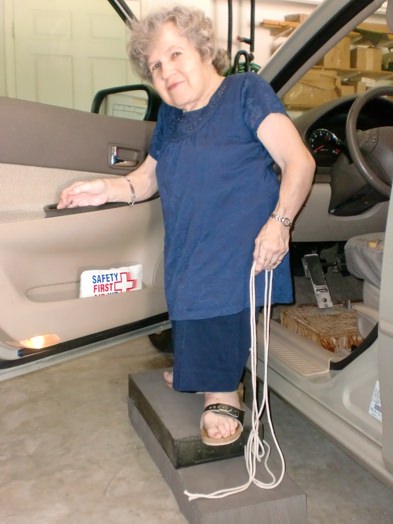
All I needed were pedal extensions, seat cushions, the seat moved forward, a smaller steering wheel, and automatic drive. The seat cushions raised me higher in the seat and a smaller wheel eliminated the need to pancake my legs between the wheel and the seat. I also appreciated the better grip and control a smaller wheel provided. Fatigue and discomfort were avoided by building a footrest platform. This removed the risk of the driving-foot falling asleep or any delay in reaction time. The platform also took away any temptation to rest my non-driving foot on the brake.

Fast forward 50 years!

Age has caught up with my husband, me, and our 2004 Mazda 6 wagon. We both use scooters for distance walking, a scooter lift to position them in the trunk, and the Mazda has clocked over 100,000 miles. We drove the Mazda for 18 years because we could not find a wagon that fit two scooters and was low enough to the ground for us to get in without a struggle.

Our long-term plan was to replace the Mazda with a Wheelchair Accessible Van (WAV), but the plan was expedited when I took the Mazda in for service. A garage worker got his foot caught on the left-foot accelerator and totaled it! This catapulted us into the market for a WAV that we can board by driving our scooters up a ramp or onto a lift.

The answer to the can you drive? question remains the same, yes. But how I accomplish this has changed dramatically. In my driving assessment this week, a Certified Driving Rehabilitation Specialist rejected the pedal extension and seat cushion adaptations as unsafe. Instead she recommended hand controls and customizing the power seat that raises me to see out the window to also provide back support. The smaller steering wheel is still an option, but this will involve serious dollars to relocate all the controls on the wheel.

The technology that makes driving a WAV possible is amazing, but buying one for more than the cost of our first home is shocking!

So now it’s my turn to ask a question. Will I be successful in purchasing a WAV without breaking the bank? Stay tuned for the answer. This post includes excerpts from Chapter 7, ‘Doing Things Differently,’ in Dwarfs Don’t Live in Doll Houses. Read more at https://angelamuirvanetten.com/dwarfs-dont-live-in-doll-houses/

Categories
Medical

GIVE BLOOD, GIVE LIFE

blood
Image by mohamed Hassan from Pixabay

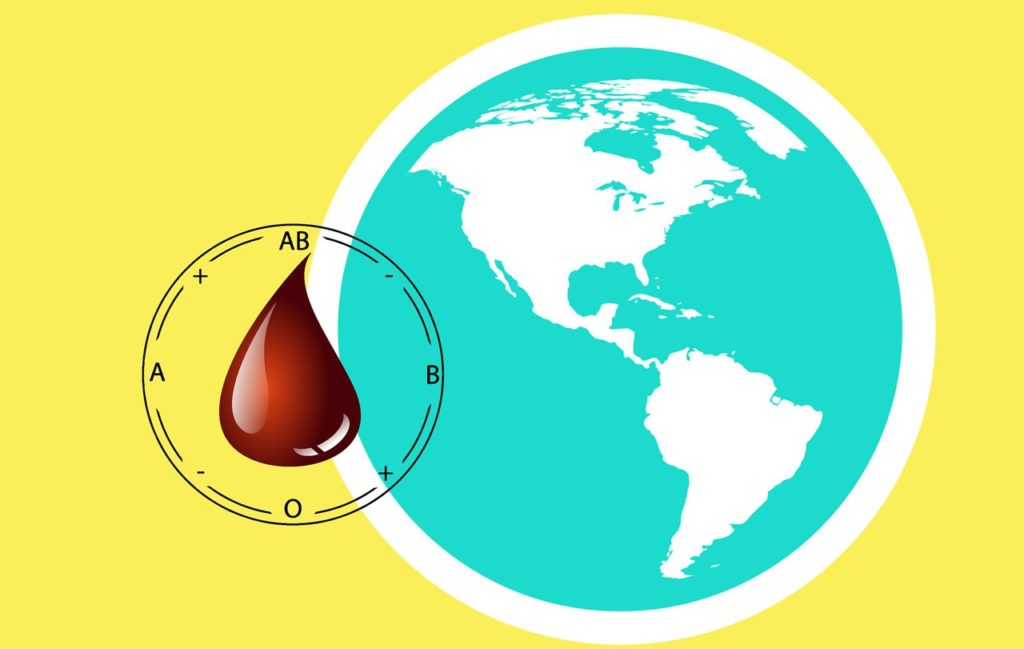
In the United States, someone needs blood every two seconds. Because blood cannot be manufactured artificially and has a limited shelf life, meeting this need involves about 38,000 donors per day and 6.8 million per year.

One in seven people entering a hospital need blood. Typically these are patients undergoing advanced medical and surgical procedures as a result of (1) traumatic injuries, emergencies, disasters and accidents, (2) dwarfism, or (3) diseases like cancer, aplastic anemia, hemophilia, and Sickle cell.

Want to subscribe to receive blog updates sign up today!

Donating blood is a simple procedure that can be done within an hour. But supply often doesn’t meet demand because restrictions reduce the number of people able to give blood. For example, people with Ebola, Leukemia, and HIV or AIDs are permanently precluded from donating. Some donor restrictions are temporary and will be lifted after a prescribed period of time, such as when flu symptoms pass, a course of medication is completed, or iron levels have increased.

Even though little people weighing under 110 pounds don’t qualify to make blood bank donations, gaining weight is not recommended to make this a temporary condition. Some people with dwarfism may meet the weight requirement, but the blood draw process is often painful and unproductive due to inability to straighten the arm at the elbow and difficulty finding a vein.

Despite the restrictions, the donor pool is plentiful with 37% of Americans eligible to donate blood. But sadly, only about 5% actually donate. One way to combat this shortage is for individuals in good health to donate blood for their own use. Self-donations also reduce the risk of incompatibility or infection.

Self-donations are common for people planning elective surgery. Many little people persevere with the difficult blood draw process and self-donate for orthopedic and neurologic surgeries. The eligibility criteria is less restrictive and even allows donor weight to be as low as 90 pounds. My husband Robert successfully self-donated two units of blood for his left hip replacement surgery. The blood was drawn a few weeks before the surgery, labeled with his name, and transported the 250 miles from Rochester, New York to Cleveland, Ohio.

When Robert was unable to self-donate for his right hip-replacement surgery, he elected a directed donation. This meant he recruited family members to donate blood that were earmarked for his use. Just as well, because the day after surgery he needed another pint of blood. But he would not let the nurse begin the transfusion until she confirmed that his cousin Tommy’s name was on the bag as the directed donor. Likewise, Monica donated blood for her son’s brain stem surgery. And during Susie’s laminectomy surgery, staff got her mother from the waiting room to quickly donate a pint.

So on Tuesday, June 14th, World Blood Donor Day, consider doing one or more of the following:

  • Wear red.
  • Encourage existing donors to continue giving blood.
  • Recruit new donors.
  • Volunteer at a blood drive.
  • Share a story expressing gratitude for blood donors who have saved your life.

This post includes references to the second book in my dwarfism memoir trilogy, “Pass Me Your Shoes: A Couple with Dwarfism Navigate Life’s Detours with Love and Faith.” Read more at https://angelamuirvanetten.com/pass-me-your-shoes/

Categories
FAQs

Can I Help You?

Ask

Independent living by people with disabilities does not equate with never needing help. But it does mean help should not be imposed against a person’s will.

Can I help you? is a fair question to ask someone with a disability. But it’s not okay to rush in with the help you think is needed and thereby create a problem. Overzealous helpers can do a lot of harm! Parents know this well. Some have sent their dwarf child to school independent in toileting and shoelaces. They become exasperated when a teacher undermines independence by carrying the child to the toilet and tying their shoelaces.

Want to subscribe to receive blog updates sign up today!

Adults with disabilities are similarly challenged by rogue helpers. Take for example when I pull into a parking space. They right away step up and open the driver’s door. Sounds like the chivalrous thing to do, right? However, it’s the opposite of what I need. I have to ask them to give my door back so I can lean on the armrest to lower myself to the ground. Likewise, it’s not okay for a public restroom attendant to use the master key to burst into my cubicle intent on providing assistance!

So instead of barreling in with unwanted aid, make an offer and wait for the person with a disability to accept or refuse. Typically, I’ll decline help when it’s something I can do myself. For example, people frequently offer to get my mobility scooter in or out of the car. But I say no thanks, because a lift raises and lowers the scooter from the trunk to the ground. Besides, if I let helpers manually lift the scooter in, it would be disconnected from the lift and I would be unable to get the scooter out of the car.

I’m willing to accept or ask for help, but only when the task is beyond my ability and to refuse means I’ll miss out on something I want to do or need to happen. Several cases come to mind: as a teenager I let my father carry me up and down stairs in a glow worm cave; in high school, I allowed class mates to carry me on a trek across farm hills to a beach party; after travelling thousands of miles from New Zealand to Malaysia, I accepted a helping hand up long flights of stairs with no handrails to enjoy hilltop scenery, and agreed to be lifted onto a chair to reach a laser machine for eye surgery.

Other situations that cause me to ask for, or accept, help include: reaching something on a high shelf; changing a flat tire; and breaking through unexpected access barriers, such as a driveway being blocked by a wall of snow created by a snow plow and an out-of-service elevator.

One final thing. If a person with a disability accepts or asks for help, it’s critical to wait for and follow instructions. Doing it wrong can inflict pain or injury. And no one needs a helper that makes a situation worse.

For more of my writing, subscribe to my weekly blog and find links to my dwarfism memoir trilogy at https://angelamuirvanetten.com.

Categories
Guest Medical

It’s OK to Not be OK

I'm not Okay
Image by S K from Pixabay

Guest post by Rev. Dr. Michael Woolf
Senior Minister, Lake Street Church of Evanston, Illinois

Over a decade ago, when I spent a summer teaching English in China, we took care to explain to students that when someone asks the question, “how are you?” the expected response was “good” or “OK,” regardless of whether those things were true. The truth—that someone is not really asking how you are—is both obvious and unstated to native English speakers, but left me with a profound awareness of how little space there is to respond “actually, I’m not OK.” As we mark Mental Health Awareness Month this May, churches have to make spaces where saying that phrase is accepted.

Want to subscribe to receive blog updates sign up today!

By all accounts the pandemic has had a profoundly negative impact on the nation’s mental health, and in the first year of the pandemic instances of anxiety or depression increased by 25% globally. What you might find surprising is that over 50 million adults, or nearly one in five Americans, struggle with their mental health. The situation is growing more dire for children especially, as we come to grips with the ways that COVID-19 has affected our society.

National Mental Health Awareness Month is an opportunity for communities of faith to take stock of how mental health is talked about within the community. Do clergy preach about mental health and affirm psychological and psychiatric care? Are congregants referred to mental health resources? Are there places where people can relate to other members of the faith community in a vulnerable way, process their emotions, and build community? The ways that a congregation answers these questions might give some insight into how far we need to go to create spaces that are affirming and safe for those struggling with their mental health.

That safe space is not just for laypeople. While studies are yet to give a definitive picture of the mental health landscape for clergy, anecdotally the situation is bleak. Many have left churches due to stress and burnout, and nearly all clergy have had to take on substantial responsibilities that they were not trained for in order to shepherd their congregation through the pandemic. The result is that, in 2021, 38% of clergy have thought about quitting full-time ministry. Congregations must also consider the ways that their policies and level of mental health acceptance can impact whether clergy feel affirmed in seeking psychological care and psychiatric treatment, or whether they feel that such actions are indicative of weakness or being unfit for leadership.

Houses of worship are important actors in community ecosystems. Most of the time, we might think of how our communities are tied to a food bank, homeless shelter, art studios, or nonprofit offices. But churches can also be a vital force for their community’s mental health by gathering community, lifting up others in prayer, and creating safe spaces where access to community support is not predicated on falsely claiming that everything is fine. This month and always, we have to dedicate ourselves to being real, vulnerable, and honest; that has always represented the church at its best, but now, as we assess the damage of COVID-19 on our mental health, it’s more important than ever.

Used by permission of The Christian Citizen, https://christiancitizen.us/, a publication of American Baptist Home Mission Societies.

Read more from a voice for people with dwarfism & disability, guided by faith and justice, at https://angelamuirvanetten.com.

Categories
Disability Rights

Ten Steps To Effective Advocacy

Target
Image by Darwin Laganzon from Pixabay

1. Care Enough To Do Something

Our sense of injustice needs to be aroused to the boiling point where we say: “Something has to be done about this!” For example, Little People are tired of being unable to reach ATMs, gas pump dispensers, point-of-sale terminals, light switches, door handles, elevator buttons, and the like.

2. Commitment Is Personal

Yes, somebody should do something about this. But we can’t expect others to do something if we won’t do anything. No one cares or understands as much as we do.

Nothing will change until “the somebody” becomes “the someone” who cares enough to do something!

Want to subscribe to receive blog updates sign up today!

3. Choose the Right Forum

When advocating against dwarf tossing as entertainment in licensed establishments, Little People of America (LPA) successfully lobbied two State legislatures to impose a ban. Local governments couldn’t stop it because the road show had left town before a meeting could be held. Congress was inappropriate because the atrocity was not a nationwide problem.

4. Competence

The ICC/ANSI A117.1 Committee on Accessible and Usable Buildings and Facilities was the best forum to make building code changes, but LPA’s success depended on competent use of the amendment process, Robert’s of Order, building code language, legislative format, the art of persuasion, and so much more.

5. Can’t Change the World Overnight

Change is incremental in building codes. The long-term goal of accessibility in public places can be set, but it must be broken down into manageable pieces. For example, from 1994 to 1998, LPA’s first bite into access barriers was to lower the unobstructed reach range from 54 to 48 inches. From 1998 to 2003, the second bite was to remove the obstructed reach in bathrooms.

6. Calculate the Cost

Advocacy can be time consuming and expensive. Be sure to carve out enough time and to allocate sufficient financial and human resources.

7. Connections and Coalitions

Build relationships to ensure communications with people on both sides of an issue. It is important to know the objections so we are prepared in advance with an answer.

Form a network with those who share the same goal. In the case of Little People, look for constituents (LPA individuals and groups), allies (other disability groups), and supporters (family, friends, and colleagues).

Don’t compete with other disability groups. For example, the interests of little people and wheelchair users differ in bathrooms. Work together for universal design and don’t pull in different directions.

8. Compromise & Creativity

LPA’s short-term agreement with elevator manufacturers allowed for a reach exception in high-rise elevators in 1998, and gave time to develop a technology solution for the 2003 revision cycle.

9. Communication keys:

  • Credibility.
  • Consistency.
  • Be concise in stating the problem and how it can be solved.
  • Counter opposing opinions.
  • Be clear and convincing to those whose minds need to be changed.
  • Don’t crumble under the pressure.

10. Churchill

Remember the advice of Winston Churchill: “Never give in; never, never, never, never.” And my personal practice? Perseverance, preparation and prayer!

These principles are drawn from lessons learned when advocating against dwarf tossing and for barrier removal in the built environment. To see these principles in action, read “ALWAYS AN ADVOCATE: Champions of Change for People with Dwarfism and Disabilities.” Buy your print, e-book, or audiobook today at https://www.amazon.com/dp/1737333600/.

Categories
Awareness

What Comes First: Person or Identity?

Compare

I was a crippled child, a handicapped teenager, and now a disabled adult. So what accounts for these changes in my condition? Apart from aging through six decades and shrinking two inches, my condition hasn’t changed. I’m still a dwarf of 40 inches with multiple, congenital, joint dislocations and fusions. The change is in the words chosen to describe the disability class of people to which I belong.

When I blogged about offensive words on November 2, 2020, I remarked, “It’s not enough to keep up with fashion trends, we must also stay current with our language.” But when advising readers to use person-first language, I passed over a seismic shift in disability terminology. Many people with disabilities now use identity-first language.

Want to subscribe to receive blog updates sign up today!

So what’s the difference?

I was introduced to person-first language in 1981 when I came to the United States from New Zealand on a Winston Churchill Fellowship. My purpose was to study disability civil rights laws and public education programs to improve the public’s attitude towards people with disabilities. That’s when I learned to use language that recognizes the person before the disability on the premise that our disabilities don’t define us. For example, instead of saying the blind man or the deaf girl say, the man who is blind or the girl who is deaf.

However, I was recently pulled up short by a tweet of Emily Ladau, author of Demystifying Disability, saying: “Calling myself a disabled person is not a denial of my personhood; it’s a celebration of part of me.” People with various disabilities have expressed a similar sentiment.

  • I Am Not a Person With Epilepsy. I Am an Epileptic.” This doesn’t imply that epilepsy defines the person, but rather it acknowledges epilepsy as part of the individual that fundamentally shapes their identity.
  • Many people proudly call themselves autistic and reject being called “people with autism.” They see autism as integral to their identity.
  • As one mother wrote supporting her daughter’s choice of identity-first language, “It’s not inherently bad to say a Down’s woman. Using person-first language is like saying, “don’t look at what’s wrong first (Downs), look at what’s right (the person).”

So where does that leave the public intent on being sensitive? Has person-first language been supplanted by identity-first language? Not necessarily. More like, it depends. Disabled people like any class of people are not all cut with the same cloth. In the case of dwarfism for example, the terms dwarf, little person, or short-statured are all in play. It’s not a case of right or wrong. Rather it depends on the person which term they prefer. Likewise, person-first or identity-first language is a personal preference which each of us are free to decide for ourselves.

So how do people figure out an individual’s preference? No need to walk on eggshells. Just ask them. But if you’re talking to, or writing about, a group of people read their literature for any preference indicators. If none are available, consider explaining your word choice.

For discussion of diverse disability issues, link to my weekly blog and dwarfism memoir trilogy at https://angelamuirvanetten.com.

Categories
Relationships

Mother’s Day Song of Praise

Mum & Me
Angela and her mother stand smiling in front of a yellow flower garden; both have short brown hair. Angela’s batik dress is ankle length with long sleeves; her mother’s floral dress is knee length with short sleeves. Her mother holds a Bible in her left hand and a jacket in her right hand. Angela’s head is at the height of her mother’s waist.

I remember with a grateful heart Barbara Mary Muir, my loving mother, whose influence in my life will never be forgotten and can never be replaced.

Praise the Lord who chose Barbara Mary as my mother.

Although my life started with grim predictions of an early demise followed by two years of institutional care, I’m thankful mom didn’t reciprocate my rejection of her when she visited. When it was time for my discharge, I rejoice that she brought me home and did not relinquish me to foster care.

Want to subscribe to receive blog updates sign up today!

If my mother had not expected the same from me as my average-size siblings—obedience, chores, and good grades—I would have grown up dependent, weak, and frustrated. In treating me according to age not size, she disciplined me when necessary and stood up to strangers who censured her for doing so in public. She offset the actions of relatives who favored me, especially elderly aunts who gave me more money than my brother and sister. On our drive home, mom insisted that I share it with them.

I’m thrilled my mother instilled a love of books and reading and always attended parent-teacher conferences to ensure satisfactory progress. She stressed the importance of education and supported me all the way to graduation from law school. My spiritual education was attended in Sunday School, church, and Bible reading.

Appreciation is due for mom’s instruction on how to live in a world which taunts those with differences. How empowering it is to understand words ignored cannot harm and smiles are stronger than scowls.

I’m glad my mother managed medical needs without (1) parading me before endless doctors; (2) overexposing me to radiation with countless x-rays for research purposes; or (3) trying useless remedies like calcium tablets, stretching, or hormones.

I’m delighted mom taught me how to be independent. She allowed me to go to kids camps and, at 15, to take a train for 300 miles to visit a girlfriend for a week.

In her quest for me to have fun like the other kids, she tried to get me a fast ride on a handheld surf board. Instead, I was dumped onto the sand when three waves piled on top of each other. My board went flying, my bathing cap was swished off, and I rode in on the bottom of the ocean floor with my feet facing their soles to the sun. Mom expected a torrent of fury when I surfaced. All we could do was laugh.

My joy is in knowing my mother’s generosity; hospitality; service to people in need; love of flower gardens, travel, theater, music, and vacations has spilled over into how I live my life. My regret is that mom took her last breath the day after Mother’s Day at age 45. Although I was not ready to say goodbye at age 26, I do not grieve like those who have no hope. I share my mother’s faith that we will meet again on the Day of the LORD. (1 Corinthians 15:51-57; 1 Thessalonians 4:13-17.)

This post is based on Chapters 1 and 2—’Understood’ and ‘Educated’—in Dwarfs Don’t Live in Doll Houses. Email angela@angelamuirvanetten.com to qualify for a new and free autographed print of this book when purchased with Pass Me Your Shoes or Always an Advocate for only $10 a piece. Click on https://angelamuirvanetten.com for details on this dwarfism memoir trilogy and subscription to my weekly blog.

Categories
Disability pride

The Gift of Being Distinctive

Different colored shoes

Short stature will give you extra opportunities. It will lift you out of the crowd. You will be noticed.” ~ David Hornstein, attorney at four-feet-seven-inches.

My first meeting with a client shattered all the stereotypes people have of how lawyers should look. In a crowded court foyer people watched me weave around people’s legs and whispered among themselves, “Is she really a lawyer?” In the office, I introduced myself and invited potential clients to come in and take a seat. Often they hesitated not sure whether to follow or wait for the “real” lawyer to come in. Parents’ faces brightened with embarrassment, when their curious child crawled under my desk and exclaimed in the midst of the interview, “Mummy her feet don’t touch the floor.”

Want to subscribe to receive blog updates sign up today!

But my ability to break free from the lawyer stereotype was helpful. My distinctive appearance made it easy for clients to identify and find me. People came into our office and before agreeing to make an appointment would ask the secretary, “Is this the office of ‘the little lady lawyer’?” Sometimes they gestured with their hand at waist level to make absolutely sure they were in the right place.

During a job search season, one attorney told me that lawyers work hard to stand out from their colleagues. In addition to a good professional reputation, a distinctive feature like a bow tie, cowboy hat, or eye glass frames serves this goal. At 40 inches in height, I don’t need such accessories. My distinctive attributes are naturally built in. People remember me!

Therefore, a special day to put my uniqueness on display is not warranted. My dissimilarity is evident every day of the year. So for those of us with visible disabilities, “National Two Different Colored Shoes Day” on May 3rd appears redundant. Then again, maybe not. Putting a different colored shoe on each foot demonstrates acceptance of differences in ourselves and others, promotes diversity in our world, and encourages us to embrace our uniqueness.

I have come to see my size is a gift that should not be wasted. I can use it to positively influence how people perceive disability, illustrate our abilities, interact with kindness, increase integration into the mainstream, and identify barriers that demand removal. I can impede the impact of negative behaviors by being impervious to the impertinence, isolating offenders, and indicting those who interfere with civil rights and impose both inequality and injustice on people with disabilities.

For You shaped me, inside and out.
You knitted me together in my mother’s womb long before I took my first breath.
I will offer You my grateful heart,
for I am Your unique creation, filled with wonder and awe.
You have approached even the smallest details with excellence;
Your works are wonderful;
I carry this knowledge deep within my soul.
Psalm 139:13-14 (the Voice)

So are you grateful for your uniqueness? Do you see it as a gift from God to be used and not wasted? Are you ready to accept and embrace it?

This post is partially excerpted from Chapters 3 and 9—’At the Bar’ and ‘Attention Gives Opportunity’—in Dwarfs Don’t Live in Doll Houses, https://angelamuirvanetten.com/dwarfs-dont-live-in-doll-houses/. Email angela@angelamuirvanetten.com to qualify for a new and free autographed print of this book when purchased with Pass Me Your Shoes or Always an Advocate.

Categories
Awareness Inclusion

Dancing Differently

Dancer Faith

Question:
What does amputation, burn injuries, deafness, autoimmune disorder, dyslexia, ADHD, multiple sclerosis, dwarfism, and blindness have to do with one another?
a) disability
b) dancing
c) different ability
d) all of the above

Answer:
d) as demonstrated by 11 celebrities with disabilities paired with professionals in Dancing with the Stars from Season 4 to Season 27.

Want to subscribe to receive blog updates sign up today!

In season 4, Heather Mills competed to show you can do anything with an artificial leg. Amy Purdy dancing with two below the knee prosthetics was runner-up in season 18. Third place in season 20 went to Noah Galloway who danced with both a prosthetic arm and leg. Judge Carrie Ann Inaba said Noah broadened her scope of what dance looks like.

In Season 6, Marlee Matlin shattered the notion that hearing the music is integral to dancing. Instead she relied on her partner to express the music to her in his body. In Season 22, Nyle DiMarco described “seeing” the music that his ears couldn’t hear. Along with memorizing the timing of his partner’s moves and scratch and squeeze signals, they danced their way to winning the coveted Mirror Ball trophy.

The season 13 winner, J.R. Martinez, has severe burns on more than 34 percent of his body. He competed to give burn survivors hope, pride in their scars, and belief in themselves while facing their fears and limitations.

Jack Osbourne, a Season 17 celebrity with multiple sclerosis, danced to raise awareness and more research. He encouraged those with MS to set and accomplish achievable goals every day. Osbourne finished third.

Attention-deficit/hyperactivity disorder (ADHD) featured as a disability for celebrity and professional dancers alike. Both Jack Osbourne and Nev Schulman—Season 29 runner uphave ADHD. Professionals Daniella Karagach, Karina Smirnoff, and Derek Hough also use dance as a place to channel their excess energy and improve focus.

In Seasons 23 and 25, Terra Jole and Victoria Arlen both reached the semifinals. Terra, who has dwarfism, announced that being different is a great thing. And Victoria, an autoimmune disorder survivor, aspires to replace the term “disability” with “different ability.”

In season 27, Danelle Umstead relied on her partner for guidance. Because she is blind, touching his shoulders or legs allowed her to feel the movement and paint herself a picture.

Just as Dancing with the Stars showcases the beauty of dance, the celebrities with disabilities demonstrated the diversity of dancers. No matter the disability, dance has a place for everyone. Wheelchair users. Cane and crutch users. People with Down Syndrome. You name it.

And as Joe Powell-Main, UK para-dance champion who performs in his wheelchair said, “Sometimes it doesn’t look like conventional ballet—people in point shoes, legs up by their ears—but there needs to be a willingness to look beyond that and see that it’s different.”

On this 40th anniversary of International Dance Day (April 29), let’s dance to improve our mood, creativity, mental and physical health, self-confidence, ability to follow instructions, and perseverance. Let’s all dance in our own different style.

For discussion of diverse disability issues, link to my weekly blog and book trilogy on my website at https://angelamuirvanetten.com.