Categories
Medical

Adapting to Changes in Climate and Age

Senior Citizens

In July 2003, Robert was shocked when we landed in my homeland of Auckland, New Zealand. He’d been there before, but was not a fan of winter visits. The 50 degree Fahrenheit drop in temperature from Florida’s 90 to Auckland’s 40 revealed Robert’s dependency on indoor temperature control. Telling him that the drop was only 27.5 degrees Celsius was no consolation.

Robert compensated by using dad’s two-month supply of kerosene for the heater in only three days! Despite being irritated by this drastic depletion in his fuel supply, my father threw open all the windows to let some fresh air into the over-heated room. Robert was shocked again. He hadn’t learned how to adapt to New Zealand’s way of staying warm—use a heater to remove the early morning chill and wear winter clothes inside.

Want to subscribe to receive blog updates sign up today!

When we flew to Sydney, Australia for more family visits, it was my turn to adapt. Shortly after a surprise 50th birthday celebration—where I was crowned the queen—I was rudely reminded of my advancing years. I fell and severely sprained my wrist the day before we flew home. I had one night to ice it, then fellow passengers across the Pacific suffered with me as I massaged myself with penetrating and aromatic extra-strength heat cream. The healing process was impeded by the need to continue lifting myself on and off chairs, toilets, and in and out of the car.

I was also losing range of motion in my ankles. The pain interrupted my sleep, reduced my limited walking distance, made stairs and curbs impossible to climb without a railing, and required avoidance of uneven surfaces like grass and gravel. After looking at x-ray images, an orthopedist came into the patient room and looked around for my wheelchair. He was amazed I could walk independently. He diagnosed severe arthritis and prescribed a scooter and lift to get it in and out of the car.

I followed up with the opinion of an orthopedist with dwarfism expertise—Dr. Mary Matejcyk, the same orthopedist who replaced Robert’s hips in 1997. She advised that the spontaneous fusion of my ankle joints was causing the pain. This sounds bad, but it was actually good news. Surgical intervention would be to fuse the joints and my ankles were doing this on their own. The only concern was that the ankles fuse in the right position for standing; thankfully, this appeared to be happening. When the fusion was complete the pain would end. And she was right.

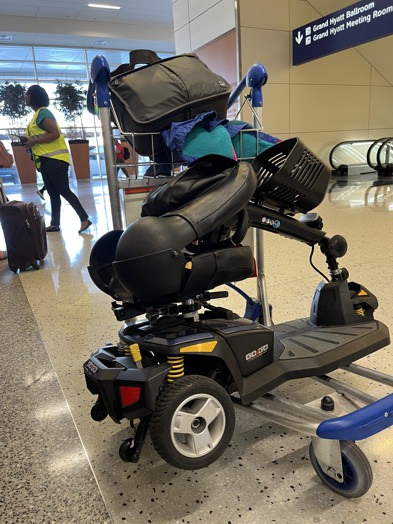
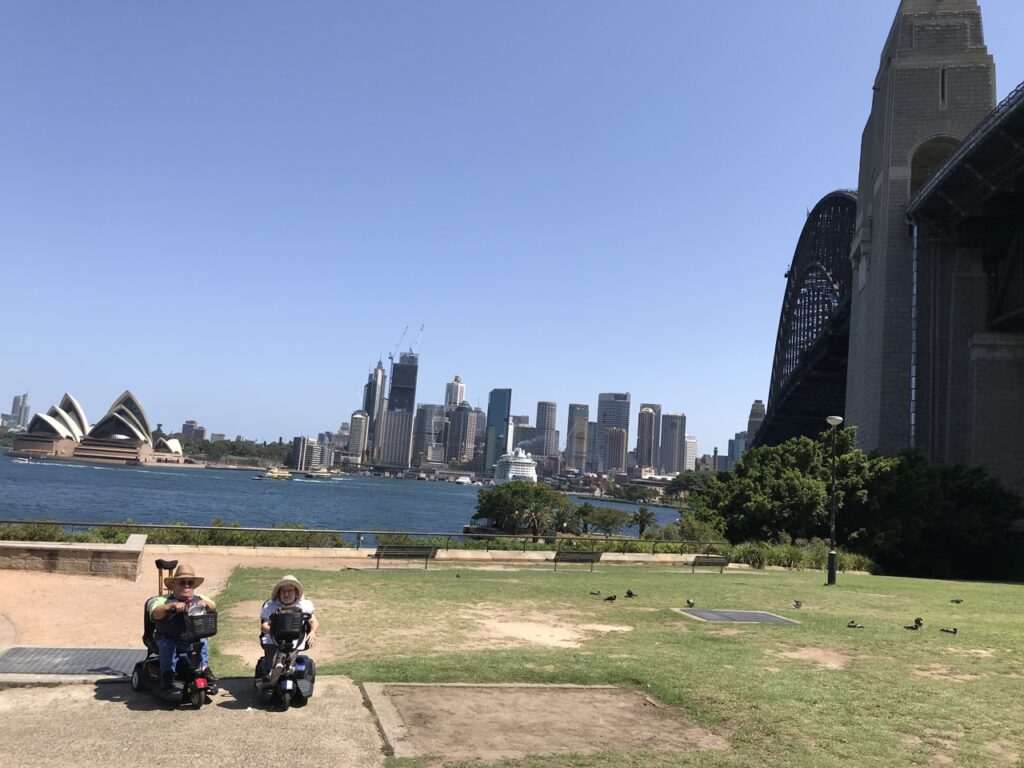
Fast forward 20 years and we are both fully retired and have achieved our allotted three-score-and-ten years. Aging issues are more prevalent with daily medications, numerous doctor appointments throughout the month, and reliance on scooters for distance. Although our schedules are more flexible, declining mobility and stamina doesn’t allow for as many activities. Indeed we wonder how we ever had time to go to work!

As we navigate our bonus years (70 and beyond), we remain thankful for the resources God has provided and whatever comes next.

[In recognition of National Senior Citizens Day on August 21, 2023, this post updates “Adapting to Changes in Climate and Age.” Angela Muir Van Etten blog (August 23, 2021).]

You may also want to read:

Categories
Little People of America

How My Life Would Be Different Without LPA

Little People of America
  • I would not have married a President.
  • I would not have attended 29 national conferences in 20 states and four countries.
  • I would not have spent so many weeks in meetings and become proficient with Robert’s Rules of Order.
  • I would not have read LPA Bylaws or cared enough to try and change them.
  • I would not have chaperoned a 17-year old at his first LPA conference.
  • I would have earned fewer frequent flyer miles.

    Want to subscribe to receive blog updates sign up today!

    • I would have stayed in fewer hotels.
    • I would have missed the free advice from medical experts in dwarfism.
    • I would not have received an LPA education scholarship.
    • I would not have posed for so many group photos.
    • The opportunity to encourage parents to raise their child with dwarfism with the same expectations and boundaries as their other children would have been lost.
    • I would not have learned the lessons that come from being in the majority.
    • River rafting in the afternoon and modeling my wedding dress in the evening would never have happened.
    • I would not have met so many celebrities or little people from all over the world.
    • Local little people communities would not have welcomed me when I moved from New Zealand to Virginia to Maryland to Ohio to New York to Florida.
    • I would get fewer emails.
    • I would not have enjoyed so much hospitality from LPA members opening their homes for meetings.
    • I would not have been a guest in so many modified LP kitchens and seen how to make my home more accessible.
    • I would not have needed a Media Resume.
    • I would have missed learning how the media censors the facts in order to promote a point of view.
    • Conservative Rush Limbaugh and Liberal Howard Stern would not have criticized me in a radio broadcast on the same day for suggesting that little people have a “cause.”
    • I would not have had to explain to so many people why the word “midget” is derogatory.
    • I would never have read so many great books written by people with dwarfism.
    • I would never have used a scooter to extend my endurance and long term joint maintenance.
    • I would not have been on the advocacy teams that defeated dwarf tossing in Chicago, Florida, and New York.
    • ATMs and credit card readers on gas pumps at my local gas station would still be out of reach.
    • My T-shirt wardrobe would be deficient.
    • I would have missed meeting other Little People with my diagnosis.
    • I would have got a lot more sleep.
    • I would have fewer friends.
    • I would not have laughed and cried so much.
    • My photo albums would not feature little people.
    • Free time would be a reality not a concept.
    • I would have missed being in the dwarfism melting pot of diagnoses, gender, ethnicity, nationality, economic and faith backgrounds.

    [In recognition of National Nonprofit Day on August 17, 2023, this post updates “How My Life Would Be Different Without LPA,” Angela Muir Van Etten blog post (September 28, 2020).]

    A reading list for digging deeper:

    Categories
    Awareness

    Dwarfism Memoir Trilogy Punctuated with Triple Threads

    Trilogy Complete

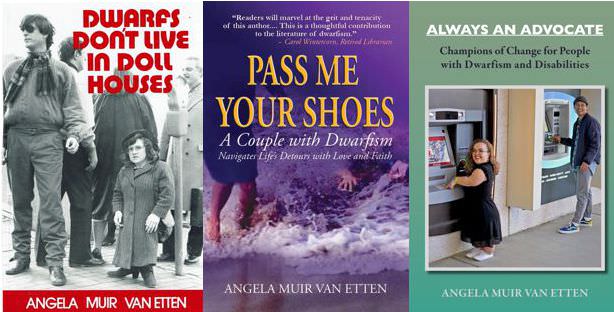
    After 33 years my dwarfism memoir trilogy is finally complete. Three books in a little more than three decades about God’s three gifts of grace in my life—faith, hope, and love. As it happens, the word “three” has emerged as a thread in this cradle to retirement memoir series.

    ALWAYS AN ADVOCATE: Champions of Change for People with Dwarfism and Disabilities (#3) is organized into three parts: Part I considers volunteer leadership challenges; Part II covers dwarf tossing; and Part III deals with equal access. The book is available in three formats: e-book, paperback, and audio.

    Want to subscribe to receive blog updates sign up today!

    Part I discusses the three times Robert or I served as LPA President during the years membership grew from about 3,000 in 1980 to 6,000 in 2006. Part II addresses LPA’s action to halt the dwarf tossing atrocity in three states—Illinois, Florida, and New York. Part III involves equal access to the built environment, education, emergency operations, housing, social security disability benefits, transportation, and voting. It took three years to break the six-inch reach barrier in the built environment standing against three of the most powerful industries in the nation—banking, oil, and retail.

    PASS ME YOUR SHOES: A Couple with Dwarfism Navigates Life’s Detours with Love and Faith (#2) is available in both print and as an e-book. Our marriage was cemented with three marriage ceremonies in 1981. The wedding and anniversary rings on three fingers of my left hand symbolize our commitment.

    Though if one may be overpowered, two can defend themselves. A cord of three strands is not quickly broken. ~ Ecclesiastes 4:12, New International Version

    Robert and I met when I came from New Zealand to America for three months on a Winston Churchill Fellowship. I obtained an American law degree after attending law school for three semesters. Despite passing the three day Ohio bar exam, I experienced discrimination in three job interviews.

    After a three-hour hip replacement surgery in 1997, Robert tanked up on three pints of blood. When he forgot to bring his electric razor to the hospital, a hand razor was off limits for three weeks because he was on a blood thinner. We couldn’t decide if the resulting beard gave him the distinguished professor or garden gnome look.

    Dwarfs Don’t Live in Doll Houses (#1) is available as an e-book and used print copies. It took three photo shoots on bitterly cold days to get the right cover photo image.

    I’m the eldest of three children and Robert has three younger brothers. Our adult height is the size of a three year old. When I was a bridesmaid for the third time, someone said, “If you’re a bridesmaid three times, you’ll never be married yourself.” Don’t believe everything you hear.

    So what do all these threes mean? Whatever you want to read into it. Maybe not a triple crown, but certainly three opportunities to learn about dwarfism in childhood, marriage, and advocacy. Read and change your life for the better!

    [In recognition of National Book Lovers Day on August 9, 2023, this post updates “DWARFISM TRILOGY COMPLETE: Recurring Pattern of Three Emerges.” Angela Muir Van Etten blog post (September 27, 2021).]

    Resources for digging deeper:

    Categories
    Accessibility

    Need Greater Equipment Access? Talk to the Manufacturer

    Elevator access
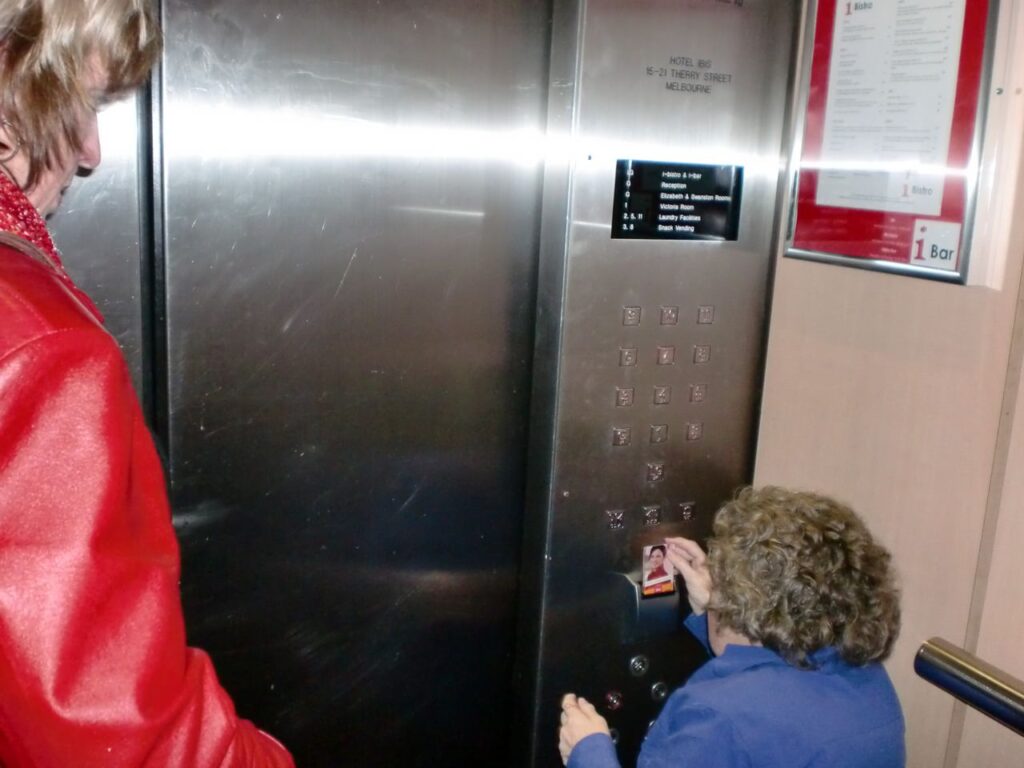
    Angela stands in front of an accessible elevator panel of floor buttons and inserts a hotel keycard to access the elevator floor selected. Her sister-in-law, Julie, stands next to her watching the wonder of independent access.

    Fifty plus years ago I rarely used an elevator. I grew up in a single story house and there were no elevators at school. However, that all changed when I began university in 1971. The law library was on the fifth floor, lecture rooms were on the sixth, and the highest button I could reach was for the fourth floor. Even the open door button and emergency telephone were out of reach!

    Ten years later, little people were still struggling to reach elevator buttons. Hotels hosting Little People of America (LPA) meetings would temporarily equip elevators with wands and stools. But this only worked if floor buttons didn’t require heat from a skin touch or the person was able to use a stool. And sadly, the accommodations were removed when the meeting was over.

    Want to subscribe to receive blog updates sign up today!

    Ten years later, little people were still struggling to reach elevator buttons. Hotels hosting Little People of America (LPA) meetings would temporarily equip elevators with wands and stools. But this only worked if floor buttons didn’t require heat from a skin touch or the person was able to use a stool. And sadly, the accommodations were removed when the meeting was over.

    So what could LPA do about out-of-reach elevator buttons? In the 1990s, when out-of-reach ATMs propelled LPA to advocate for lowering ATMs in the ICC/ANSI A117.1 Committee on Accessible and Usable Buildings and Facilities (ANSI Access Committee), we discovered that the reach range code section applied to everything open to the public activated with a push, pull or turn. Removing the six-inch reach barrier for ATMs would also bring elevator buttons within reach of at least a half million people with dwarfism, limited upper arm strength and movement, and other disabilities.

    After vigorous debate in February 1996, the ANSI Access Committee agreed to LPA’s proposal to lower the unobstructed side reach from 54 to 48 inches in the second draft revision of the ANSI Access Code. Although the elevator industry was generally willing to meet the 48 inch standard, they sought an exception for buildings with more than 16 elevator stops. Without this exception, the industry would be boxed in between a 48 inch high side reach and a 15 inch low side reach needed to accommodate people who are blind; this left insufficient room for floor buttons in high rise buildings. The industry needed time to re-engineer the control panel.

    LPA agreed not to fight the exception sought by the National Elevator Industry Institute (NEII) in the 1998 ICC/ANSI code given their commitment to form a Task Group to understand the access needs of little people and explore ways of providing 100% elevator access in the future. At the same time, LPA put the industry on notice that we would propose removal of this exception in the 2003 revision cycle.

    After meeting with LPA representatives three times, NEII came up with a technology solution designed to enable little people to reach ANY floor destination. With technology comparable to setting the time on an alarm clock,people use an up or down scan button to select a floor destination. The LPA/NEII proposal was accepted at the May 2002 ANSI Access Committee meeting and appears in § 407.4.8, ICC/ANSI A117.1-2003.

    Yet despite this technology breakthrough being added to the ANSI Access Code, I have yet to see this feature on any elevator. Please comment if you have seen a floor destination scan button in service? This post was based in part on excerpts from two books in my dwarfism trilogy memoir: ALWAYS AN ADVOCATE: Champions of Change for People with Dwarfism and Disabilities and Dwarfs Don’t Live in Doll Houses. Book details and buy links are found at https://angelamuirvanetten.com/books/.

    Categories
    Accessibility

    The Long Road to Update Federal Reach Guidelines

    Reach Us

    People with disabilities celebrate National Disability Independence Day on July 26. And Little People of America (LPA) also celebrates July 23, 2004—the day the Access Board published a final reach range rule making public facilities more accessible to at least a half million people with dwarfism, limited upper arm strength and movement, and other disabilities.

    The Access Board is an independent federal agency responsible for developing and maintaining accessibility guidelines for the construction and alteration of facilities covered by the ADA of 1990 and the Architectural Barriers Act (ABA) of 1968.

    The ADA applies to places of public accommodation, commercial facilities, and State and local government facilities.

    The ABA covers facilities designed, built, or altered with Federal funds or leased by Federal agencies.

    Want to subscribe to receive blog updates sign up today!

    In 1994, the Access Board established an advisory committee to review and recommend changes to update the 1991 ADA Accessibility Guidelines (ADAAG). When LPA learned that the committee was tentative about recommending a reduction in the unobstructed side reach from 54 to 48 inches, Robert Van Etten and I drove almost 400 miles to a July 7, 1996 committee meeting. We fervently advocated for breaking the six-inch reach barrier. We were ecstatic when the Advisory Committee’s recommendation to the Access Board included a side reach of 48 inches!

    It took another three years before the Access Board published a Notice of Proposed Rulemaking (NPRM) to jointly update and revise its ADA and ABA Accessibility Guidelines. I coordinated LPA’s advocacy in support of lowering the side-reach to 48 inches by encouraging LPA’s members, allies, and disability organizations to send comments to the federal Access Board.

    Although the Access Board rejected the Advisory Committee’s 48-inch recommendation, I believe this flawed decision swayed several hundred to make comments favoring the six inch reduction. I prepared and submitted LPA’s official comments—a 25-page document that took more than 45 hours to prepare. During the NPRM comment period, LPA members also testified at public hearings in Los Angeles, California, and Arlington, Virginia.

    After the public comment period closed, I represented LPA and recruited local LPA members to attend Access Board informational meetings on October 24-25, 2000, in Washington, DC. Their purpose was to determine the effect a 48-inch standard would have on manufactured equipment and newly constructed building elements. In a jaw-dropping moment, ATM manufacturers announced that their new generation of machines would meet the 48-inch standard! Our jubilance couldn’t even be dampened by the gas pump manufacturers’ continued fight for an exception.

    Another four years passed before the final rule was published on July 23, 2004. Euphoria barely described the joy of finally seeing the 48-inch standard accepted in the new ADAAG. Federal law now mandated this accessible height for ATMs and everything open to the public activated with a push, pull or turn.

    Yes it was disappointing to see gas pump manufacturers granted an exception for machines installed on existing curbs and allowed installation of operable parts on gas pumps as high as 54 inches. But victories are celebrated and disappointments motivate us to keep advocating for change.

    You may also want to read:

    Categories
    Celebrations

    Third Year Blog Anniversary Favorites

    check mark
    Image by OpenClipart-Vectors from Pixabay

    “Water Adventures.” August 8, 2022. https://angelamuirvanetten.com/water-adventures/

    This post includes scenes from the second book in my dwarfism memoir trilogy, “Pass Me Your Shoes: A Couple with Dwarfism Navigates Life’s Detours with Love and Faith.”

    “Finding Hugo: Our Wheelchair Accessible Van.” September 26, 2022. https://angelamuirvanetten.com/finding-hugo-our-wheelchair-accessible-van/

    Mickey’s comment: “Angela you look like a pilot of a jet.”

    Want to subscribe to receive blog updates sign up today!

    “Add Teeth Not Candles for Birthday of Air Carrier Access Act.” October 3, 2022. https://angelamuirvanetten.com/air-carrier-access-act/

    Lissette’s comment: “I enjoy reading your blog. Through your words I have found many answers to questions I didn’t even know there could possibly be solutions / answers. Keep informing us. We appreciate you sharing your knowledge. God bless you.”

    “Lessons From My 40-Year Law Career.” October 10, 2022. https://angelamuirvanetten.com/lessons-from-my-40-year-law-career/

    Excerpt:Many prospective employers can’t imagine a client having confidence in the ability of a 40-inch-tall lawyer. Thankfully, I had enough imagination for both of us.”

    “Dwarfism Sensitivity & Awareness.” October 24, 2022. https://angelamuirvanetten.com/dwarfism-sensitivity-awareness/

    Mark’s comment: “Good stuff on here.”

    “UK Travel: Challenge, Church, and Cuisine.” October 31, 2022. https://angelamuirvanetten.com/uk-travel-challenge-church-and-cuisine/

    Excerpt:We felt the access challenges were worth it to soak in more British culture and cuisine. Did it really matter that we had to leave our [bed and breakfast] bedroom door ajar because we couldn’t reach the door handle?”

    “MAKING PUBLIC COMMENTS: Time Wasted or Well Spent?” November 7, 2022. https://angelamuirvanetten.com/making-public-comments-time-wasted-or-well-spent/

    This post is based on events discussed in the third book of my dwarfism memoir trilogy, “ALWAYS AN ADVOCATE: Champions of Change for People with Dwarfism and Disabilities.” https://angelamuirvanetten.com/always-an-advocate/.

    “Why Are You So Short? Is the Answer in the Genes?” November 21, 2022. https://angelamuirvanetten.com/why-are-you-so-short-is-the-answer-in-the-genes/

    Excerpt: “Every day little people are asked to explain why they’re so short. But let’s pivot to a more important question. Is it legal to use genetic information against people whose genes identify a disability?”

    “Disabled Caught In Homeless Crisis.” December 19, 2022. https://angelamuirvanetten.com/disabled-caught-in-homeless-crisis/

    Excerpt: “People with disabilities make up almost one quarter of the half million plus homeless in America. . . The magnitude of the crisis mandates that we “Give justice to the poor and the orphan; uphold the rights of the oppressed and the destitute.” Psalm 82:3, New Living Translation.

    “Defendants Feign Ignorance When Hit With ADA Complaints.” January 30, 2023. https://angelamuirvanetten.com/defendants-feign-ignorance-when-hit-with-ada-complaints/

    Excerpt: “31 years after the ADA’s January 26, 1992 effective date, we’re expected to believe defendants don’t know wheelchairs can’t climb steps, people using walkers and canes have trouble opening heavy doors, and little people can’t reach high counters!” 

    “Dwarfs Don’t Live in Doll Houses: 35-Year Anniversary.” April 10, 2023. https://angelamuirvanetten.com/dwarfs-dont-live-in-doll-houses-35-year-anniversary/

    Because human behavior has not changed, the e-book remains relevant for ongoing disability issues and serves as a time capsule for how little people and their families experienced life prior to disability civil rights laws.

    “Barrier Removal Beats Awareness.” May 8, 2023. https://angelamuirvanetten.com/barrier-removal-beats-awareness/

    Carol’s comment: I’m 4’6.” I once put in a complaint at a supermarket about POS machines attached to the checkout counter above my view. I had asked how people in wheelchairs managed, and the assistant tried to tell me they raised themselves on one hand and did it with the other. “NO they don’t,” I declared.

    To subscribe to my weekly blog—a voice for people with dwarfism & disability guided by faith and justice—go to https://angelamuirvanetten.com/blog/.

    Categories
    Celebrations

    Unforgettable 60th Birthday in Alaska

    Robert on platform between train carriages
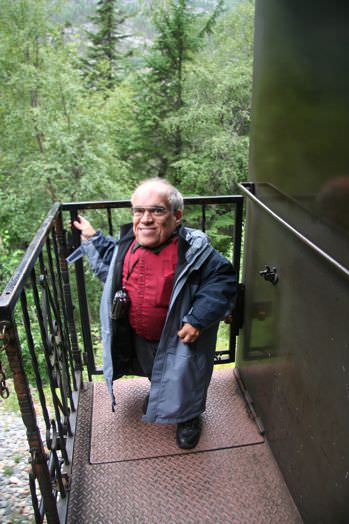
    Robert on apron deck between carriages on White Pass & Yukon Route Railway in Alaska

    As a nod to Alaska’s State flower—the Forget-Me-Not—we remember Robert’s unforgettable 60th belated birthday celebration cruising with friends Rick and Bette from Vancouver, Canada to Whittier, Alaska. This was a definite upgrade for Robert and Bette’s tradition of celebrating their same age birthdays together.

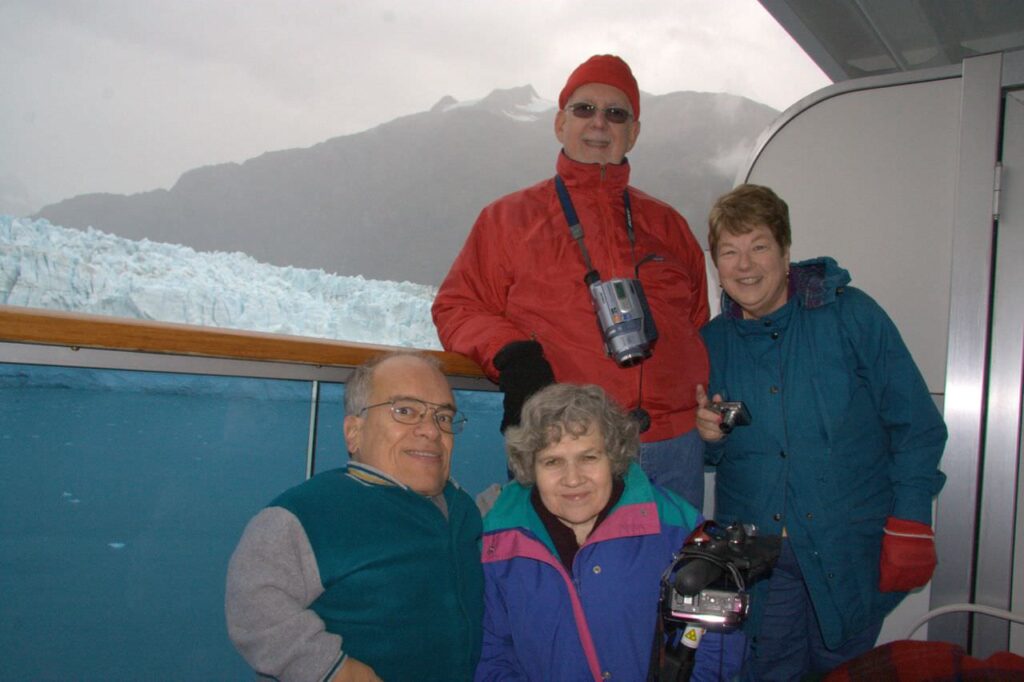
    In Glacier Bay, we all bundled up to enjoy the view and sound of glaciers calving while sipping hot chocolate on our cabin balcony.

    Want to subscribe to receive blog updates sign up today!

    Hoffmans on balcony
    Birthday buddies on ship balcony

    We enjoyed our dinners in the supposedly sold out dining room with assigned seating and a personal waiter. Rick credits Robert and me scootering up at just the right moment for four seats to miraculously materialize.

    Disembarking and boarding from a ten story ship was complicated by the rise and fall of the tide. Riding down the gangway on the scooter could be a gentle slope on departure and a steep incline on the return several hours later. Despite the gangway slope being reduced by attaching to higher or lower ship decks, it could still be so steep that the scooter teetered at the top! Nonetheless, several crew ensured we boarded safely.

    At our first stop in Ketchikan, the cold August temperature required dressing in layers. The downside came when it was time to go to the bathroom and peel off all those layers. We spent our shore time appreciating the world’s oldest collection of native American totem poles and the Great Alaskan Lumberjack Show. Robert felt much older than 60 seated in the outdoor bleachers when staff gave him a woollen lap blanket akin to those used in nursing homes.

    In Juneau—Alaska’s capital city—our local tour guide was a relative of Robert’s brother-in-law. He had great insights on how to survive in Alaska. The tip that sticks with me is “cotton kills, wool warms.” In bringing us to the Mendenhall Glacier he lamented how global warming was shrinking the glacier. Indeed glaciologist, Mike Hekkers, reported that for 20 years the glacier has retreated over 160 feet per year.

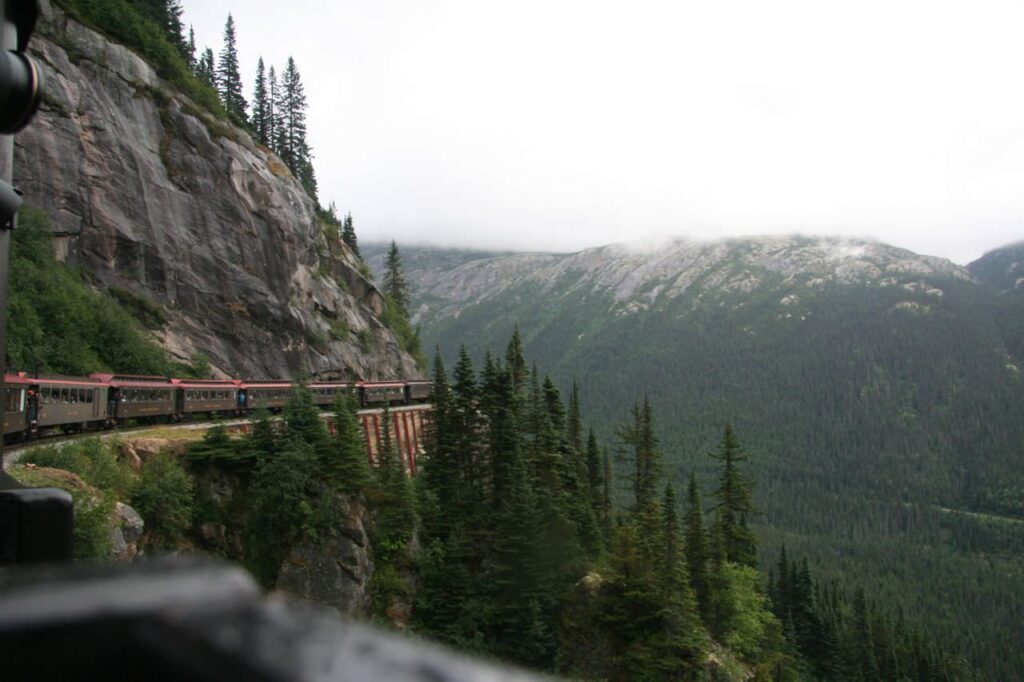
    In Skagway we tackled an incline that rivaled the ship’s gangway. After boarding the White Pass & Yukon Route Railway, the train climbed grades of up to 3.9 percent to ascend 2,865 feet in only 20 miles. Completed in 1900, the railroad was built in treacherous conditions during the Klondike Gold Rush to link the Yukon and other booming gold-mining districts with tidewater at Skagway.

    This narrow gauge railroad is an International Historic Civil Engineering landmark comparable to the Eiffel tower, Statue of Liberty and Panama Canal. Just as significant to us was the carriage equipped with a wheelchair lift and, for our amusement, “handicapped eating” presumably intended as “disabled seating” since there was no food service.

    Train carriages
    Train carriages winding their way along the ledge of a rock faced cliff above and below

    Our cruise ended in Whittier. Robert’s cousin Carol not only met us at the terminal, but also for the first time. Carol and her two dogs graciously welcomed us as a guest in their home in Anchorage and played tour guide for a few days.

    How about you? Any unforgettable birthdays or destinations?

    You may also want to read:

    Categories
    Independence

    Fighting for Independence

    Statue of Liberty

    This July 4th as we reflect on America’s independence, let’s consider the fight for independence continuing for people with disabilities.

    My parents understood right from the start that it was vital to my development as an independent mature person that I be treated according to my age not my size. This meant not being given a pass on chores, discipline, or responsibilities. In their wisdom, they didn’t fuss over or do everything for me.

    Want to subscribe to receive blog updates sign up today!

    As a result, I loved the independence of going when and where I wanted when I started driving at age 18. The only problem was that this car was a machine that had to be fueled, watered, oiled, lubed, aired, and cleaned. I never had to think about such things before. Now it was my responsibility and dad insisted that I look after the car myself. One day our different views on the subject clashed.

    Mo, a family friend, noticed that one of the tires needed air and offered to take the car to the garage for me. I was about to let him, when dad butted in and said, “No Angela, you take it to the garage yourself.” I was fuming. What did it have to do with dad anyway? Mo was willing to take it, so why not let him? But there was no chance of that now, dad had said enough for Mo to withdraw his offer. I had no choice but to take the tire in myself.

    It didn’t take me long to realize that dad was right. I had to learn how to look after my own car. Along with the privilege of driving, came the responsibility of caring for it. This was the beginning of achieving independence for myself as an adult and laid the groundwork for advancing independence for others.

    A subtle challenge to independence comes from those who insist on helping people with disabilities when we don’t need it. We must stand firm against such offers so as not to erode our independent living skills or give in to patronization. In the times we do need help, we will ask for it.

    As discussed in my dwarfism memoir trilogy, I have supported independent living principles through my marriage, career and volunteerism. For example:

    • I joined forces with Robert Van Etten, a rehabilitation engineer and my husband, who worked to improve the independence of individuals with disabilities at home, on the job, and in public places through environmental changes and adaptive equipment.
    • I served as a board member of a Center for Independent Living in Cleveland, Ohio and was appointed by Florida’s governor to serve on the Florida Independent Living Council.
    • I was a coordinator and advocacy specialist for the Coalition for Independent Living Options in Stuart, Florida.
    • As a volunteer with LPA, I led the charge for little people—and a half million others whose disability involved a reach limitation—to gain independent use of public facilities such as ATMs, bathrooms, elevators, and gas pumps.

    What can you add about the disability fight for independence?

    This post is drawn from excerpts and concepts in my dwarfism memoir trilogy, https://angelamuirvanetten.com:

    • ALWAYS AN ADVOCATE: Champions of Change for People with Dwarfism and Disabilities
    • PASS ME YOUR SHOES: A Couple with Dwarfism Navigates Life’s Detours with Love and Faith
    • Dwarfs Don’t Live in Doll Houses
    Categories
    Etiquette

    HANDSHAKES: Purpose, Etiquette, and Alternatives

    Handshake

    The handshake is an ancient greeting dating back to 900 BC to seal alliances and 500 BC to convey peace and confirm the absence of a weapon. Centuries later, the Quakers handshake communicated a sense of equality between the parties. Today, handshakes are used to welcome, accept, honor, respect, congratulate, and express peace, goodwill, or gratitude.

    For people with dwarfism, the handshake also represents what little people are looking for in society—acceptance, equality, and respect. Nobody has expressed this better than Paul Steven Miller, Equal Employment Opportunity Commissioner (1994-2004):

    Want to subscribe to receive blog updates sign up today!

    Little people are looking for a handshake not a handout.”

    At four-feet-five-inches, Miller was initially denied a welcome handshake from prospective employers. After graduating from Harvard law school, 45 law firms denied him equal treatment, ignored his credentials, and failed to offer him a job. One employer shamelessly disclosed fear that his presence in the law firm would cause clients to mistake the office for a circus freak show! (All this prior to Americans with Disabilities Act (ADA) protections.)

    Although job discrimination is still widespread, in post ADA America, applicants with dwarfism now enter an interview room standing on solid legal ground. Nonetheless a candidate at an in-person job interview must still convince an employer that they are the right person for the position. A good handshake can help deliver this message.

    According to the founders of National Handshake Day—celebrated on June 29—when two people shake hands, especially when eye contact is made, they are more likely to have a personal connection and relate positively to the other person. CareerBuilder.com adds that shaking hands, makes people twice as likely to remember you than if you didn’t shake hands. Even though little people don’t need any help getting people to remember us, our handshake must still stand up to scrutiny and not make a bad impression.

    A handshake needs to strike the right balance. A firm handshake reflects a confident personality, but a tight grip is too aggressive. In contrast, a floppy handshake projects insincerity or weakness. Yet a soft hold with no eye contact is preferred in East Asian nations.

    As a little person with arthritic hands and finger joints I have regularly regretted responding to a handshake gesture. The pain inflicted lingers long after the greeter lets go my hand. Consequently, as politely as possible, I reluctantly buck etiquette and decline to reciprocate. However, I avoid disrespecting the person extending their hand to me by explaining my predicament and offering an alternative greeting.

    The fist and elbow bumps popularized during the COVID-19 pandemic has made it easier for people to accept alternative greetings. Other no-contact greetings include:

    • Hand over heart: placing your right hand over your heart.
    • Wai bow: palms pressed together and a small head bow so that your fingers touch the gap between your eyebrows.
    • Shaka sign: three middle fingers folded down while the pinky and thumb are pointed upward and then shaking your hand back and forth.

    So what’s in vogue in your world: handshakes or alternate greetings?

    You may also want to read:

      Categories
      Medical

      “STAY SAFE:” Avoid Slips, Trips, and Falls

      During National Safety Month, the National Safety Council (NSC) designated one week in June to focus on staying safe from slips, trips, and falls. This caught my attention given my being banded as a fall risk when checking into an outpatient clinic or during a hospital stay. And according to the Centers for Disease Control and Prevention (CDC), my past falls have doubled my chances of falling again.

      Did you know that falls are the second leading cause of unintentional injury-related death? According to Injury Facts®, 42,114 people died in falls at home and at work in 2020 and account for almost one-third of non-fatal injuries in the U.S. Nearly seven million people seek emergency room treatment for a fall and 20 percent are seriously injured.

      Want to subscribe to receive blog updates sign up today!

      Although falling is prevalent among seniors, this post focuses on the fall risk among little people. Although I don’t have data on how many of us are falling, I suspect the fall risk is greater than in the average population. Several factors and conditions contribute to our risk, including the following:

      1. Physiological
      • Impairment in the lower body due to spinal issues or orthopedic limitations. For example, my knees and ankles are fused so I can’t catch myself when I trip.
      • Foot conditions like pain, neuropathy, and hard-to-find well-fitting footwear.
      • Balance problems.
      • Use of mobility devices.
      • Vision problems like retinal detachments.
      • Lack of sleep due to sleep apnea or pain, for example.

      2. Environmental

      • Clutter.
      • Throw rugs or loose carpet.
      • Uneven walking surfaces, like pavers or cracked concrete.
      • Cords on the floor or jutting into the path of travel.
      • Poor lighting.
      • Stairs that are broken, uneven, or without handrails.

      3. Pharmaceutical Agents

      • Taking five or more medications per day.
      • Tranquilizers to treat anxiety and insomnia.
      • Narcotics taken for acute or severe pain.
      • Antihistamine side effects causing drowsiness and reduced coordination, reaction speed and judgment.
      • Over-the-counter medicines affecting balance and gait.

      The good news is that with appropriate interventions little people can drastically reduce the risk of falling.

      Physiological contributors can be mitigated with assistive devices like a cane or walker; sensible shoes that fit well, give good support, and have nonskid soles; grab bars for the shower or tub; a shower chair and hand-held shower nozzle. Exercise can improve strength, balance, coordination and flexibility. Annual vision checks and eyeglass updates are key to spotting and avoiding perilous situations.

      Environmental hazards can be reduced by clearing the floor of anything someone might trip on—clutter, electrical and phone cords, small furniture, throw rugs, and the like. Immediately repair loose, wooden floorboards or carpeting, and clean spilled liquids, grease or food. Install handrails on both sides of a stairway. Maintain good lighting indoors and out. Limit the need for stools by keeping things used often on lower shelves. Use stools with a handle to hold onto. Never stand on chairs, tables or any surface with wheels.

      Pharmaceutical risks can be eased by a doctor or pharmacist medication review.

      What fall prevention tips can you add?

      You may also want to read: